

To Restore Montana’s Prairie Streams, Smithsonian Researchers Are Thinking Like Beavers
Smithsonian researcher Maya Rayle is studying whether artificial beaver dams can revive the stream valleys of the Great Plains.
:focal(700x347:701x348)/https://tf-cmsv2-smithsonianmag-media.s3.amazonaws.com/filer_public/08/3f/083f9449-de90-4e38-9466-0ac4d9d333fe/20260519-002mr.jpg)
A first-person account from Maya Rayle, an ecologist with the Great Plains Science Program.
“Looks like she needs our help. Want to come see a calf get born?” Montana rancher Dale Veseth asks as we sit around the kitchen table enjoying his wife Janet’s homemade blueberry-banana bread.
The timing is perfect. I have just finished sharing updates from the first season of a multi-year restoration study I am conducting with the help of the Veseth family. From native reseeding to virtual fencing to rangeland monitoring, everyone at the Veseth Ranch is deeply committed to improving the health and sustainability of the land. They have been testing a new stream restoration technique, and my role is to measure how well it works.
On an iPad, security camera footage shows a heifer laying down in a corner of the corral. She has been struggling to give birth for the last 45 minutes, so it’s time to help.
At the corrals, we coax the heifer into the barn. Dale and Jim, who works alongside him at the ranch, secure the heifer so she cannot back up or injure anyone. Jim tells me to hold her tail out of the way. I can see a tiny hoof poking out.
Nearby, Sallie, an intern from Nebraska who is apprenticing for the summer to learn about sustainable ranching, rolls her sleeves up and plunges her arm inside to find the calf’s hooves. After a few tries and some help from Dale, she loops a wire around both hooves, then replaces it with a more comfortable webbing strap.
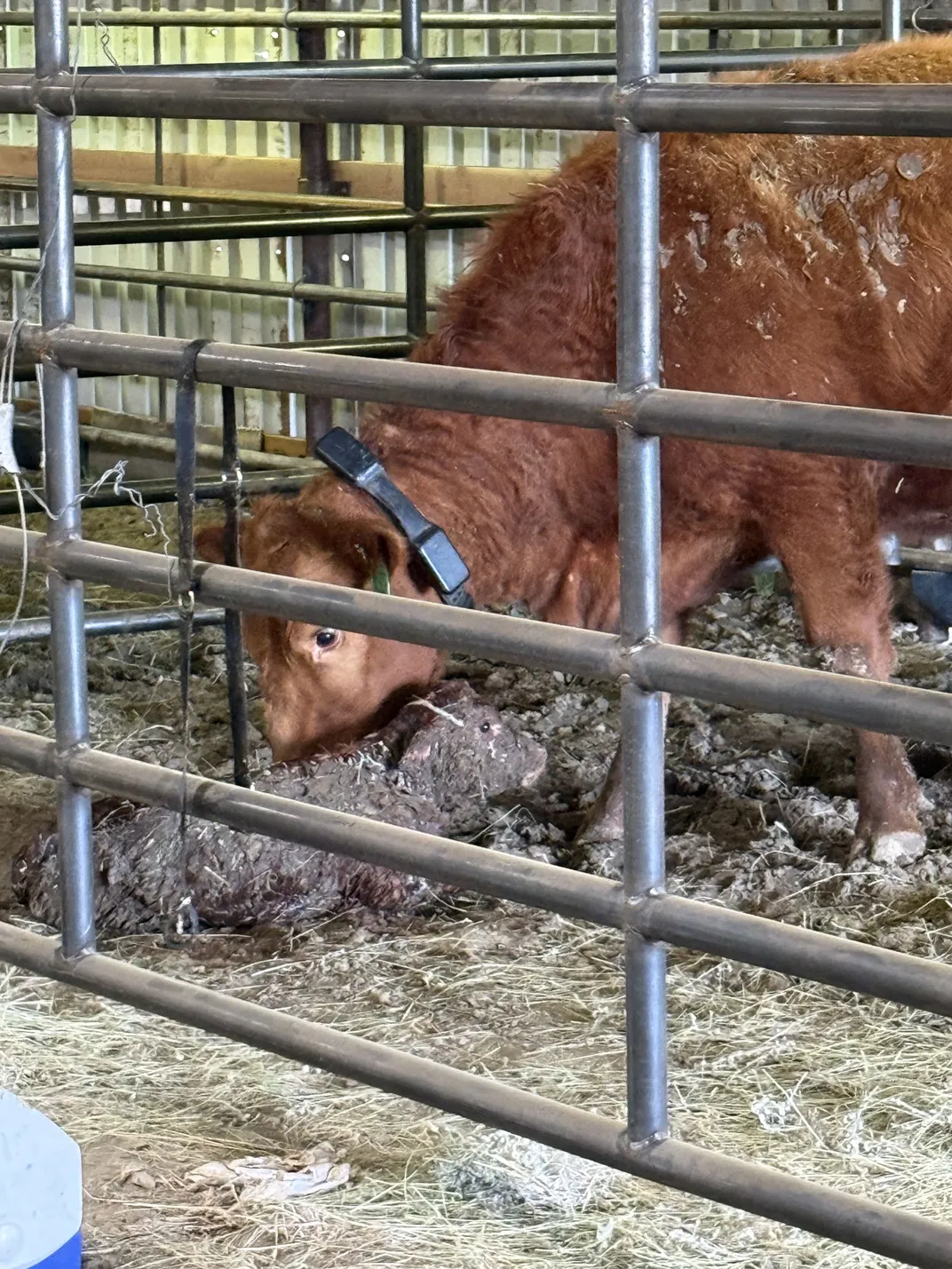
Sallie and Dale pull gently, timing each effort with the heifer’s contractions. A tiny nose pokes out, and then a goop-covered calf drops to the ground.
Once the calf and people are safely out of the way, we release the heifer. She backs up, then lowers her head to sniff her baby. She starts to lick her new calf, and we step away to let them bond.
How on earth did I, a researcher working for the Smithsonian, end up in this barn?
After graduating from a masters program at the University of Wisconsin-Madison, I drove out to Malta, Montana in July 2024 to begin a research fellowship with the Smithsonian’s National Zoo and Conservation Biology Institute's Great Plains Science Program.
Coming from the Pacific Northwest, the grasslands of Montana were completely different from any ecosystem I had ever experienced. Rolling hills and sagebrush hide a surprising amount of wildlife: songbirds, deer, owls, raptors, and snakes. I have heard stories of moose, mountain lions and even grizzly bears wandering out onto the prairie. By some measures, the region I work in is among the most remote places in the lower 48 states.
I’ve seen the best sunsets imaginable, and have watched the northern lights a few times. When the light hits just right, the hills turn blue and roll like ocean waves. The Milky Way during a new moon or before moonrise is unreal.
After my year-long fellowship ended, I was hired as an ecologist to continue working under the guidance of Smithsonian research ecologist Andy Boyce-Pero on questions related to microclimate, bird biodiversity, and stream health.
Water is critical in a prairie environment, where it rains just 14 inches in a good year (for comparison, Washington, D.C. gets about 42 inches annually.) Many vulnerable species of grassland birds and other animals rely on stream corridors for protection from the heat and shelter from predators. Additionally, pronghorn, deer, elk, coyotes, salamanders, frogs, toads, snakes, prairie fish, dragonflies and other animals use these wetlands as breeding habitat, movement corridors or refuge during periods of extreme heat or cold.
Most prairie streams dry up at some point in the summer. But streams that hold water longer will keep the surrounding plants greener, and connected floodplains sustain nutrient-rich shrubs and grasses, which can support cattle grazing.
Whether the goal is to run a successful cattle operation that can last generations or increase biodiversity, everyone here wants healthier streams.
Stream Degradation and the Role of Beavers
Unfortunately, many prairie streams are in poor condition. Both current and historical practices have contributed to their decline.
When livestock overgraze riparian areas, they can trample streambanks and eat much of the vegetation that stabilizes them, which further erodes the streams and makes it difficult for woody plant communities to reestablish. Dams built to form stock ponds, along with large-scale irrigation, have depleted many watersheds.
Historical land-use practices have played a role as well. Homesteaders cut down streamside trees to fuel riverboat boilers, build homes, and supply posts for fencing.
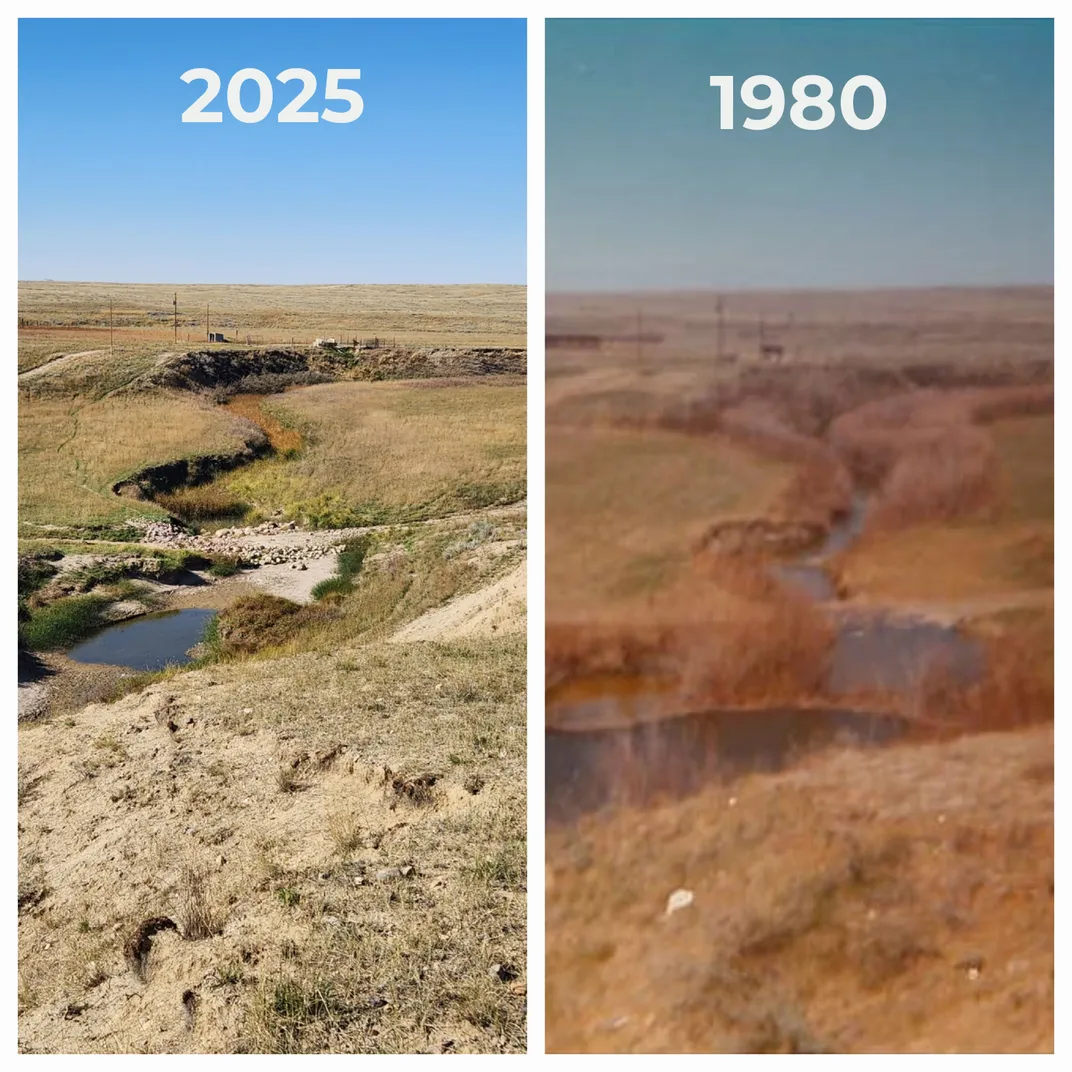
Although many people associate beavers with mountain streams, the animals used to be extremely common in the rivers and creeks of North America’s Great Plains before intensive trapping wiped them out.
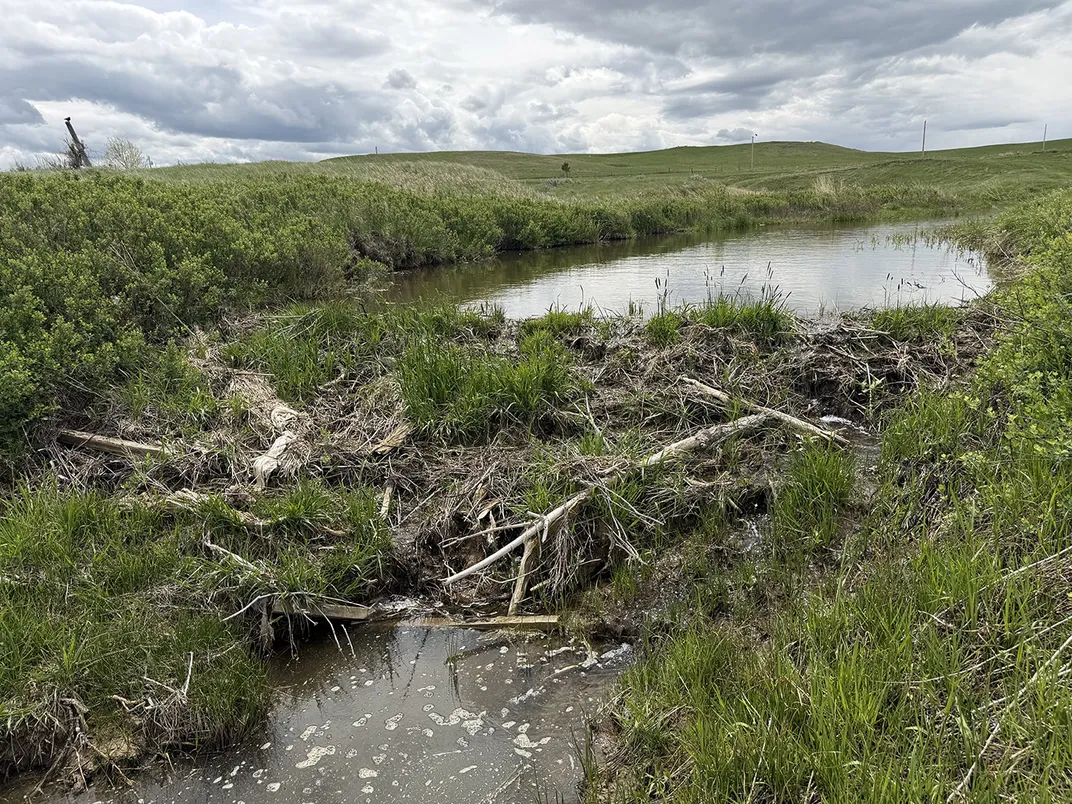
Beavers can change stream ecosystems in ways that benefit not just themselves, but countless other plants and animals. The dams they build slow down water flow, raise the water table and create a complex web of interconnected channels that support plant growth along the banks. The dams also retain water longer, which creates the moist conditions needed for plant and animal species to thrive. In turn, woody plants like willow and cottonwood flourish along stream valleys, and beavers rely on these species for food and shelter from predators.
Degraded streams can become stuck in a negative feedback cycle, with each heavy rain worsening the damage. After storms or rapid snowmelt, surges of water carve their way through narrow, deeply incised stream channels, causing erosion and cutting steeper walls into the stream banks. Because the channels are so narrow, it forces large quantities of water to rapidly move through the stream which creates a lot more destruction, while a shallower and wider stream would dissipate the force of the water. Instead of percolating slowly down into parched soil, the water rushes downstream and leaves the system.
A healthy prairie stream has woody plants, interconnected channels and beaver dams that work together to slow water and push it across the surrounding floodplain, where it can nourish plant roots and form pools that sustain aquatic insects, amphibians and other wildlife.
These streams often need a nudge in the right direction to become healthier again, and beavers cannot return to fix problems until the conditions are good enough.
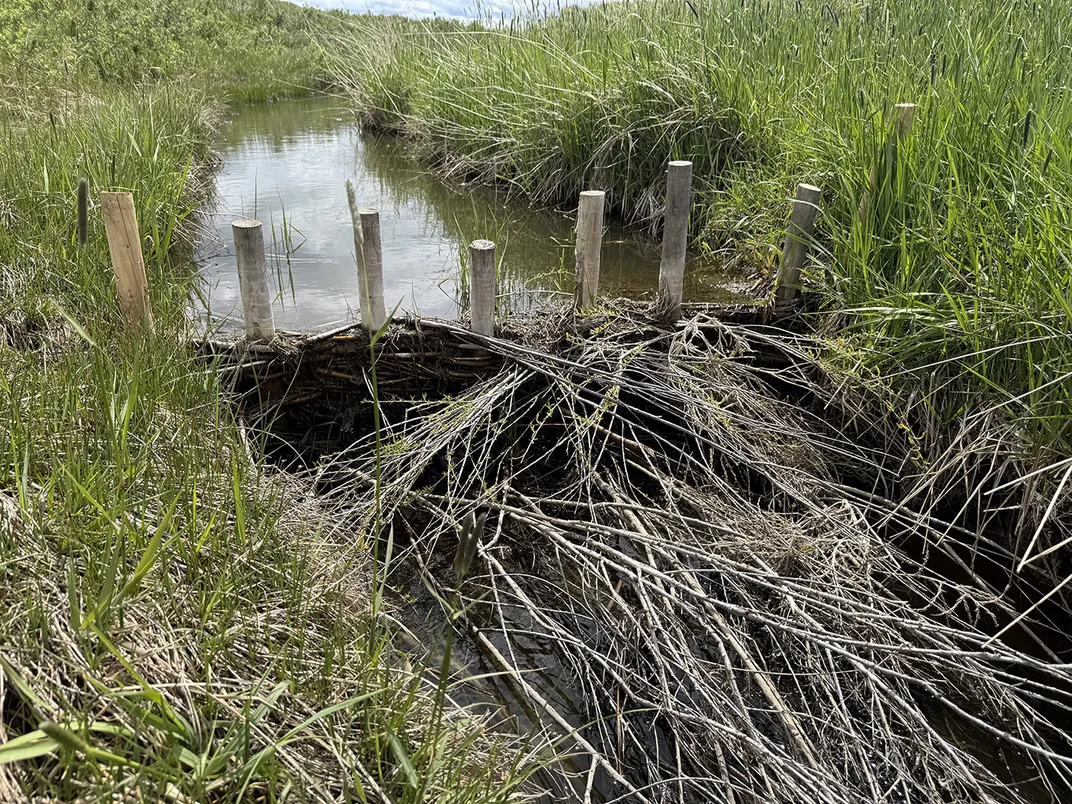
That’s where process-based restoration comes in: it's an ecological management approach that aims to use nature to restart the formative processes that create a healthy environment. The technique I'm studying includes construction of beaver dam analogs, human-made structures that are designed to mimic the stick-and-mud dams that beavers naturally build. By slowing water down during flood events and retaining moisture later into the summer, these structures can create a cooler and wetter habitat that better supports a variety of wildlife — and maybe eventually, beavers. Whether beavers end up recolonizing the area or not, the goal of this technique is to restart the processes that lead to healthier stream systems.
So far, though, most of the research on beaver mimicry as a restoration tool has taken place in wetter mountain ecosystems, including the Pacific Northwest and the mountains of Utah.
Can this approach work in drier ecosystems like the prairies of Montana? Working together with landowners like Dale, and in partnership with a variety of non-profits and government agencies interested in stream health, I am trying to find out.
The Study Approach
In the summer of 2025, I established 13 research sites across 6 different counties in north-central Montana, most of them on private land. This summer, I will be adding even more.
Each site includes one zone left unrestored as a control, and another where stream restoration has taken place. By comparing conditions between the two, we can measure how well the restoration is working. Repeating this process across multiple locations and over multiple seasons strengthens our conclusions and means we can be more confident in what we find.
/https://tf-cmsv2-smithsonianmag-media.s3.amazonaws.com/filer_public/fa/64/fa647d2a-2de1-472b-b337-ff69c6f5e161/mtcountiescurrentstudyarea-maya_rayle.jpg)
To understand whether process-based stream restoration works in temperate grasslands, we are tracking changes in biodiversity, soil moisture and climate resilience.
We expect a restored stream to have increased levels of water, vegetation and insects — changes that could support more species of breeding birds over time.
We are directly measuring soil moisture throughout the summer because soil moisture directly correlates with plant growth. By examining how quickly soils dry after rainstorms, we can determine whether restored zones stay wetter for longer. This is important because wetter soil leads to more vegetation growth and extends seasonal greenness deeper into the summer, which is good news for cattle, deer and birds. Sage grouse females, for instance, will protect their fledglings in stream corridors during the late summer and early fall.
We are also interested in climate resilience, or how well ecosystems withstand extreme weather. Breeding birds reduce their activity during heat waves, which can have direct costs on reproductive success. To test whether restored zones provide cooler environments during heat, we compare bird activity in restored and unrestored areas. We would expect to see smaller changes in activity in healthier stream areas.
/https://tf-cmsv2-smithsonianmag-media.s3.amazonaws.com/filer_public/79/1d/791d2eb9-9345-41d1-815a-5072ea16aefd/20260519-006mr.jpg)
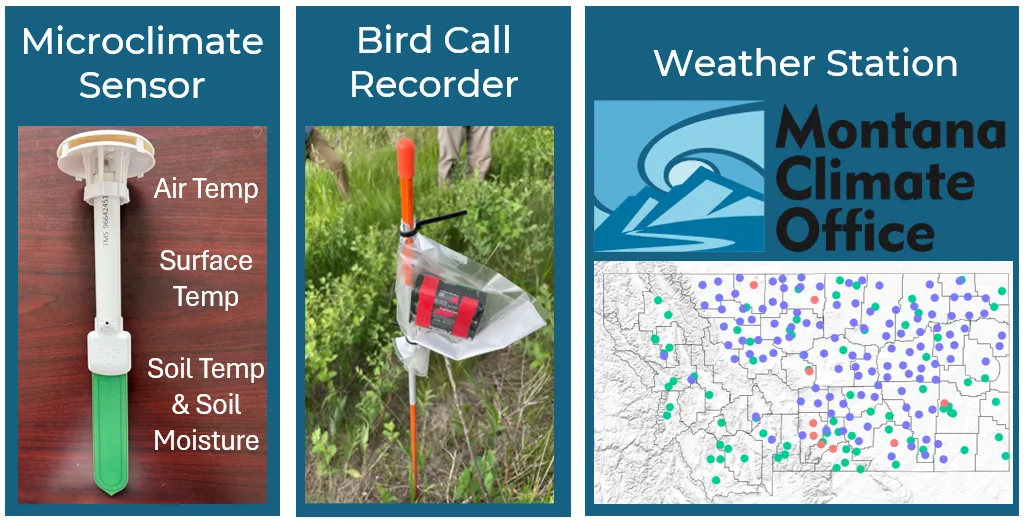
To answer all these questions, we rely on a set of helpful tools: microclimate sensors, bird-call recorders and weather stations.
Microclimate sensors collect measurements every 15 minutes, recording air, surface and soil temperature, as well as soil moisture. Bird-call recorders capture snippets of birdsong multiple times a day throughout the summer. Later, we use an AI classifier to identify species and look at how often various species of birds are calling.
Weather data comes from the Montana Mesonet, a network of weather stations that take measurements every hour. This lets us identify heat waves and rainstorms.
Our collaborators on this study include a variety of government agencies, nonprofits and private landowners across the region.
Organizational collaborators include National Wildlife Federation, The Nature Conservancy, the Bureau of Land Management, American Prairie, World Wildlife Fund, and Montana Fish, Wildlife, and Parks.
Field crews from the Montana Conservation Corps and Anabranch Solutions build the restoration structures. These crews are made up of young adults from all over the country, most of whom are experiencing rural Montana for the first time. One rancher told me he once persuaded a vegetarian crew member to try beef raised on his ranch. She enjoyed it, he said, and it became a highlight of his week.
The project is still in its early stages, and so is the data analysis. But I have begun pairing soil moisture measurements with rainfall data to better understand how effectively the streams retain water.
The chart below compares soil moisture at two sensors placed along the edge of the stream channel: one in an unrestored control area and another in a restoration zone. The top graph shows rain recorded by the nearest weather station. The red lines show how quickly the soil moisture dries after storms. If the ground around the stream can retain moisture for longer (and dry more slowly), then it indicates that restoration is helping streams hold water after rainstorms.
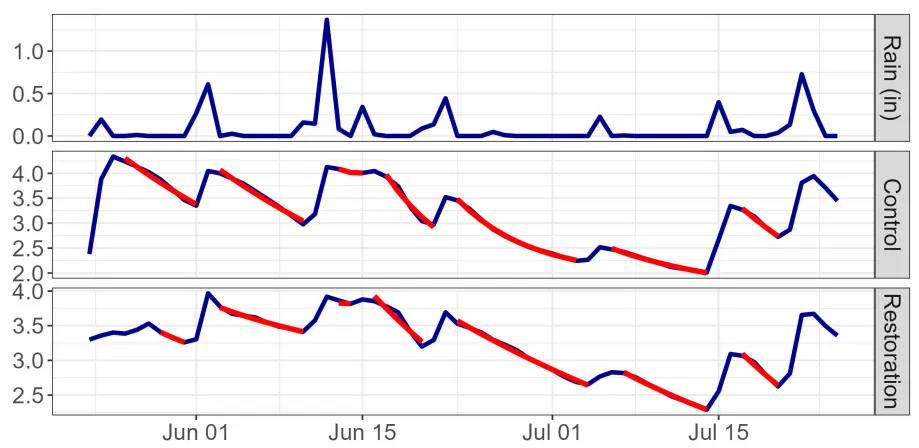
The ecological processes started by stream restoration will take time, which is why it's crucial for us to measure how the restoration efforts improve conditions over a span of several years. Though we hope to detect the beginnings of change soon, it might take decades to see the full effects — like healthier floodplains, more resilient ecosystems and maybe even the return of thriving beaver populations.
Fortunately, landowners like Dale take a long-term perspective on the land and want to see it flourish in the future. His family has been living and working here since 1942.
The calf whose birth I witnessed will be sustained by the grasslands throughout its life, and that ultimately depends on water. Healthy streams that can retain and spread moisture across the floodplain are essential for cattle production, and they also support bird communities and a wide range of other wildlife.
I say goodbye to Dale, Jim, and Sallie, who head off to check on more heifers, and drive south in my pickup to the stream restoration site on their property. The structures here were built by a Montana Conservation Corps Crew in August of 2025. I previously set up the microclimate sensor array shortly after they finished, then left it through the winter. Now, it is time to see how it fared.
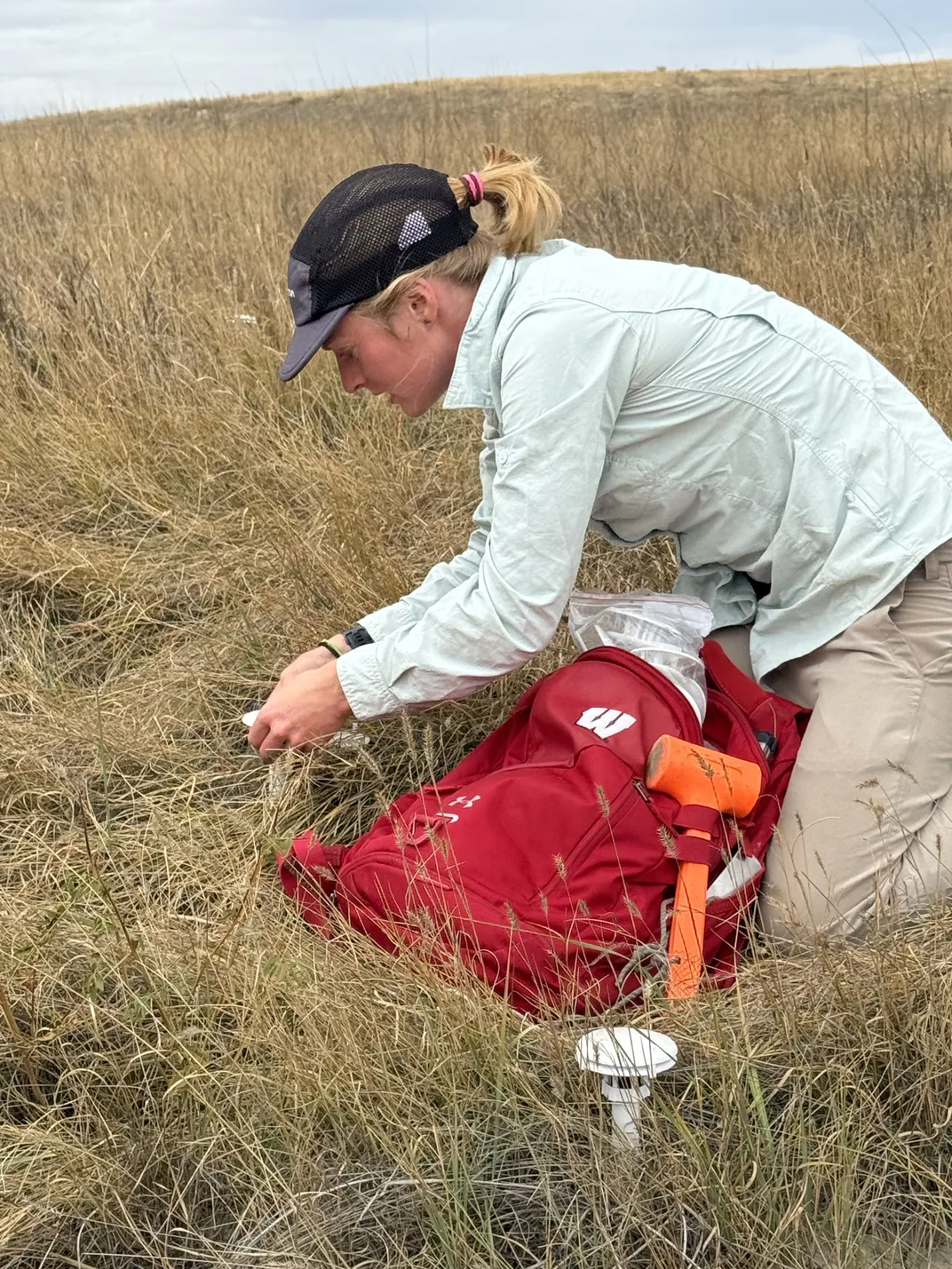
I pull the pickup to the side of the road and make an unfortunate discovery along the creek: the sensor array has been trampled by cows. This happens all the time in fieldwork, so I take it in stride. A few of the sensors are still upright, but many have been pulled out of the ground and most have lost their sun shields.
I log the damage in a field survey on my phone, since I can’t use compromised data from an out-of-position sensor. Then I pull out my laptop, connect a USB connector to the top of the sensor, and manually download the data. One by one, I fix all issues with the sensors by putting them back in position in the soil, replacing any missing sun shields, and replacing sensors that are no longer working. Once all the data is collected and the equipment is reset, it’s time to leave the creek.
I’ll be back soon to visit with Dale, Janet, Jim, and Sallie, to put out bird recorders, and to check the microclimate sensors again. In the months ahead, I will have enough data to start detecting changes, which will help us determine whether the restoration is changing how these prairie streams function.
Stay tuned!
This work was made possible through support from the Bureau of Land Management, National Fish and Wildlife Foundation, John and Adrienne Mars, and the Smithsonian Institution.