

Secretary Lonnie Bunch Says the Smithsonian Keeps ‘The Nation’s Memory’ in an Exclusive Essay for America’s 250th Birthday
The acclaimed historian and head of the Institution argues that the semiquincentennial presents the perfect opportunity for Americans to consider their nation’s past and future
:focal(1350x900:1351x901)/https://tf-cmsv2-smithsonianmag-media.s3.amazonaws.com/filer_public/ad/bc/adbce946-c932-42ef-934e-6920a52a0f08/secretary-summer26.jpg)
In the summer of 1976, I visited the National Mall as a graduate student to attend the Smithsonian’s Bicentennial Folklife Festival (then called the Festival of American Folklife). It was exhilarating to sample so many foods and drinks, to observe so many styles of American music, dance, arts and crafts—bluegrass and glass blowing, square dancing and Alabama folk painting. I witnessed the lacrosse stick making and intricate basket weaving of Indigenous tribes, and I marveled at so many workers representing the country’s prosperity and progress.
In an essay for the festival program, famed anthropologist Margaret Mead responded to those who criticized celebrating in the aftermath of a recession, the Vietnam War and the resignation of a disgraced president. “It is quite true we are living through difficult times. But life does not stop for difficult times,” she wrote, noting the parallels to a 19th-century America still divided by the Civil War and in the midst of a worldwide recession. “The celebration of our 100th anniversary as a nation also took place in a time of trouble,” Mead wrote, “but taking pride was a good thing. We gained strength and looked to the future.”
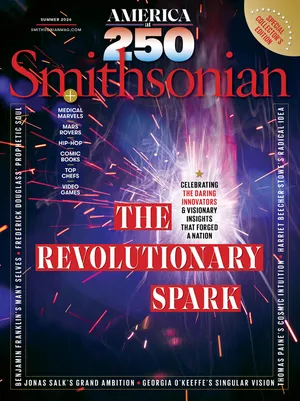
(This essay is a part of Smithsonian magazine's special "America at 250" issue. Read more of our coverage here.)
The 2020s have been difficult, too—a pandemic, economic uncertainty, the proliferation of international conflict, increasing political and social strife at home. It is more urgent than ever for us to remember that the nation was forged by resilience and shaped by those who believed in its highest ideals.
The 250th anniversary of American independence is the perfect time to explore and explain our country, to tell its stories, and to help the nation grapple with its complicated history. The Smithsonian is taking this moment not simply to reflect on where the nation has been, but to consider who we are as a people and where we want to go together.
As the Smithsonian marks this milestone anniversary, we embrace our role as keepers of the nation’s memory. That means we must tell the unvarnished histories of the extraordinary and the ordinary, the moments of glory and infamy alike. America has always been a work in progress, embodied by the notion in our Constitution’s preamble that seeking “a more perfect Union” is an underlying need for our democratic republic. An incomplete telling of our past, with rough edges smoothed, inhibits the country’s ability to forge a better shared future.
Since its inception, the Smithsonian has worked to capture and even contribute to the nation’s innovative spirit. We have not only collected items like Thomas Edison’s light bulb, Alexander Graham Bell’s early sound recordings and Grace Hopper’s computer code; we have helped support and inspire innovators like the Wright brothers as they sought to expand the limits of human achievement.
American creativity is not constrained to the scientific or technological, though: It is also woven into the cultural, social and constitutional ideas that represent our willingness to take risks and challenge social norms.
Think of the ways artists like impressionist painter Mary Cassatt, writer James Baldwin, actor Paul Robeson, dancer Isadora Duncan and boxer Muhammad Ali helped people see the world anew. Musicians, including jazz pioneer Ella Fitzgerald, rock ’n’ roll legend Bruce Springsteen and folk icon Woody Guthrie, have influenced the world in their own ways as much as any inventor. As documentarian Ken Burns remarked, trumpeter Louis Armstrong is to 20th-century music “what Einstein is to physics.”
Speaking of Einstein, how different would our nation’s innovation look were it not for the immigrants who often inspire new thinking? The list of Americans—not by birth but by choice—who profoundly changed the nation is as long as it is disparate, with myriad backgrounds, ethnicities, religions and ideologies. So many who emigrated here, drawn by the promise of freedom and opportunity, gave rise to modernity and progress in a way that would otherwise be hard to imagine.
So too did many who arrived on these shores not of their own free will, as well as their descendants, who saw in our young nation the potential to eventually become the land of freedom.
Perhaps the most consequential innovation of the United States is the philosophy at the heart of our democracy: that all of us stake an equal claim to life, liberty and the pursuit of happiness. Indeed, it is foundational to our form of governance.
What is innovation if not the combination, refinement and application of ideas to create something new? Some believe that when American colonists met at the Albany Congress of 1754 to pursue a treaty with Native Americans and to discuss centralizing the colonial governments, Benjamin Franklin took inspiration from the Six Nations of the Haudenosaunee (Iroquois) Confederacy, whose representatives attended. Their democratic structure—separation of powers, an analogue to a bicameral legislature, the codifying of rights and responsibilities—-provided a model for our founding documents and our system of governance, encouragement that the colonies would be stronger together than apart.
One of those documents, the Declaration of Independence, was created to persuade rather than govern. Like the Constitution and the Bill of Rights, it is one of the world’s most influential and enduring road maps. When Abraham Lincoln drafted the Gettysburg Address, he echoed the Declaration, noting that the nation had been “conceived in liberty and dedicated to the proposition that all men are created equal.” He once referred to the Declaration as an “immortal emblem of humanity.”
Those ideas matter. They are the echoes of our ancestors whispering to us, urging us to embrace the better angels of our nature. We are a nation founded by people who rejected rule by monarchs, improved over time by those who believed in the ideals and potential of this bold experiment of a democratic republic governed by its citizens.
The fact that we are such a disparate group of individuals, each free not only to vote for our government representatives but also to criticize them, lends weight to the notion that America is an aspirational idea as much as it is a place. A government of the people, by the people and for the people is as ingenious and transformative as anything that can be patented or purchased.
Did you know? Founding fathers found inspiration from Indigenous nations.
-
The Six Nations of the Iroquois Confederacy developed the laws of the Great Peace, a democratic constitution that predates the United States.
-
From east to west, the members of the alliance included the Mohawk, Oneida, Onondaga, Cayuga, Seneca and Tuscarora.
-
The confederacy, properly called the Haudenosaunee Confederacy (people of the long house) is considered the oldest participatory democracy in the world.
-
In 1987, the U.S. Senate recognized the influence of the Haudenosaunee constitution on the Founding Fathers, who “greatly admired the concepts, principles and governmental practices of the Six Nations of the Iroquois Confederacy.”
As Mead rightfully noted, our national achievements are worth celebrating. But this milestone must be about more. It should encourage us to honor those who struggled and sacrificed along the way for liberty, equality and justice. It should provoke us to think about what this country is and what it can become. It should challenge us to live up to the principles enshrined in our founding documents and embodied by all the people who worked to make real the promise of the nation.
This moment is a chance for the Smithsonian to help a nation find common ground, to reinvigorate our country’s character and to fuel the fire for freedom and democracy. It is why we are approaching the 250th with four aims: to celebrate, to contemplate, to commemorate and to commit to our civic responsibility as Americans. And this year, for the first time, instead of bringing American culture to the nation’s capital, the Folklife Festival will work with dozens of other community festivals, venturing off the Mall and into parks, streets and other public venues throughout the country.
Let us embrace the moment together. Let us revel in our past and look toward the future.
(This essay is a part of Smithsonian magazine's special "America at 250" issue. Read more of our coverage here.)
Subscribe to Smithsonian magazine now for just $19.99
This article is a selection from the Summer 2026 issue of Smithsonian magazine