
/https://tf-cmsv2-smithsonianmag-media.s3.amazonaws.com/filer_public/43/c3/43c31d6b-0041-444c-a2b4-ffe1dfa01db4/gettyimages-2289911756_1.jpg)
The Founders of the ‘New York Times’ Pledged to Cover ‘Every Subject of Public Importance.’ 175 Years Later, the Paper Continues to Publish ‘All the News That’s Fit to Print’
Much has changed since the publication debuted on September 18, 1851. What hasn’t changed, staff members say, is the paper’s mission
:focal(2080x1340:2081x1341)/https://tf-cmsv2-smithsonianmag-media.s3.amazonaws.com/filer_public/43/c3/43c31d6b-0041-444c-a2b4-ffe1dfa01db4/gettyimages-2289911756_1.jpg)
On August 30, 1851, journalists Henry Jarvis Raymond and George Jones laid out their vision for a newspaper they planned to launch the following month. Called the New-York Daily Times, the publication would be printed daily on a 24-column folio sheet, with morning and evening editions priced at 1 cent each.
Raymond, a politician who later co-founded the Republican Party, would serve as the editor of this new daily paper. Jones, a former banker, would be its publisher and financial manager.
Along with presenting the news of the day, the co-founders asserted in their prospectus, the paper would share literary reviews; art criticism; and editorial articles “written with all the ability, care and knowledge which the abundant means at the disposal of the subscribers will enable them to command.”
/https://tf-cmsv2-smithsonianmag-media.s3.amazonaws.com/filer_public/28/d0/28d021b1-f50e-4dcd-80f0-0ff611f51ecd/gettyimages-1410622687.jpg)
The newspaper’s columns, the pair promised, “will be free from bigoted devotion to narrow interests and will be open, within necessary limitations, to communications upon every subject of public importance.”
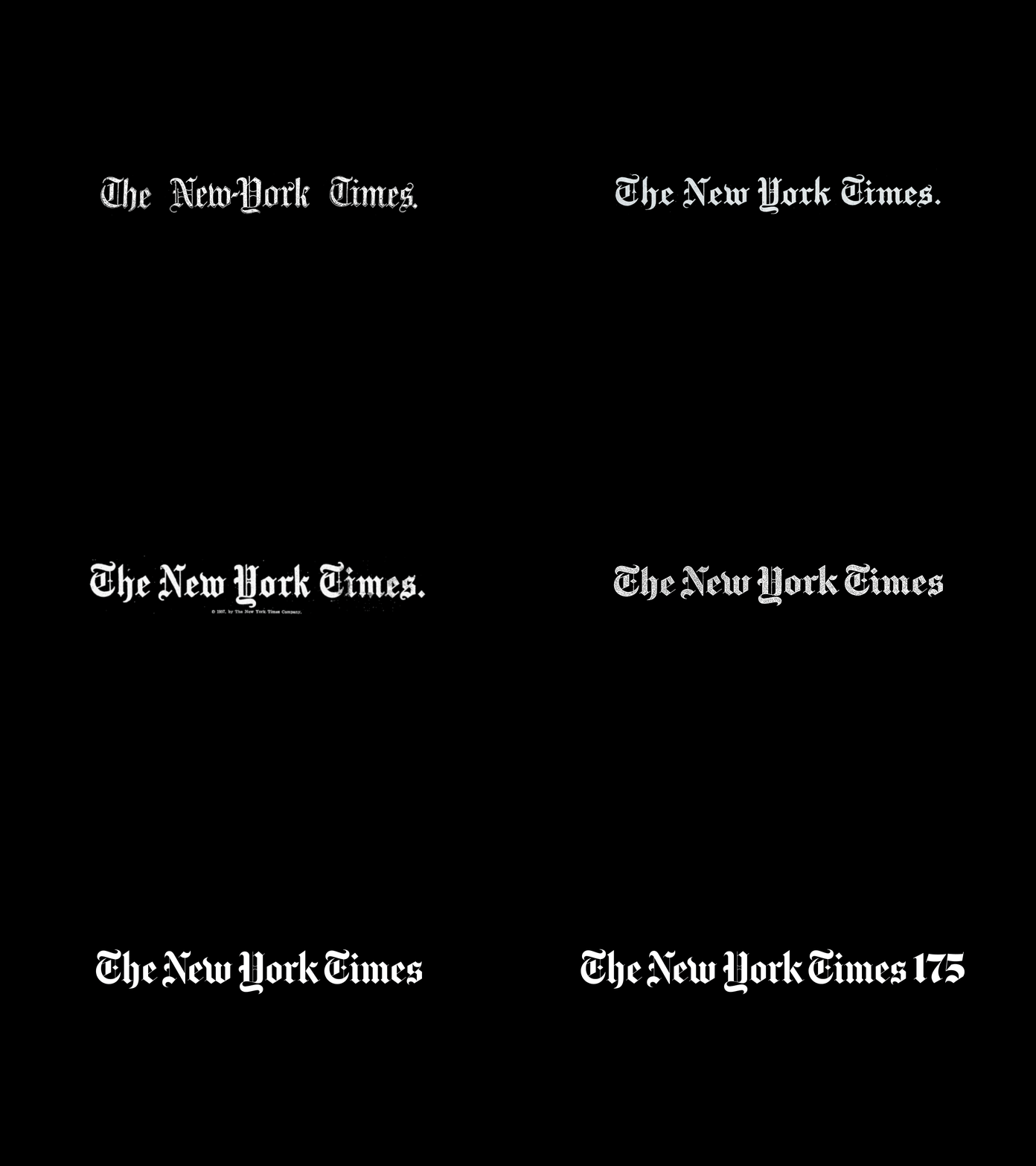
The first issue of the New-York Daily Times was published on September 18, 1851. Now, 175 years later, both the hyphen and the word “Daily” are gone, but the New York Times remains.
The Times has established itself as “the newspaper of record,” documenting the most significant events in both national and international history. Its past notable headlines include “President Lincoln Shot by an Assassin” in 1865, “Titanic Sinks Four Hours After Hitting Iceberg” in 1912, “The War in Europe Is Ended!” in 1945, “200,000 March for Civil Rights in Orderly Washington Rally” in 1963 and “Men Walk on Moon” in 1969.
And the paper’s influence is still growing: This year, the New York Times Company announced that it had amassed more than 13 million subscribers, “the largest paid subscriber base of any news organization in the world.”
/https://tf-cmsv2-smithsonianmag-media.s3.amazonaws.com/filer_public/80/42/80423af7-a149-43a0-9a3b-673ab73d565b/gettyimages-1288515217.jpg)
The Times has, of course, evolved since its founding. The past two decades in particular have ushered in rapid changes, says Sam Dolnick, a deputy managing editor at the paper.
Dolnick began working at the Times in 2009. Over his 17 years with the company, he’s seen it become “a completely different newsroom,” he says. “When I came, it was a print newsroom built around the print newspaper and print deadlines and the print front page. Now, it’s a digital newsroom around the clock, around the globe.”
David W. Dunlap, a longtime Times employee, serves as curator at the Museum at the Times, a showcase of the paper’s history on the 15th floor of the company’s New York City headquarters. At the museum, Dunlap—who started his career at the Times in 1975, right out of college, as a clerk in the Washington bureau—never loses sight of the publication’s beginnings. He manages archival materials and offers private tours to colleagues and invited guests. (The museum is closed to the public.)
On view at the museum is the front page of the paper’s very first edition. The article given the most space in the September 1851 layout centers on a Pennsylvania “fugitive slave riot.” Earlier that month, in the Lancaster County borough of Christiana, a group of African Americans killed a Maryland enslaver as he attempted to capture men who had fled from bondage on his farm.
Raymond wrote multiple editorials about the event, condemning the killing while acknowledging that the men had “acted from their conscientious convictions of duty.” The editor argued that he understood “how such convictions may incline others to abstain from all active agency in sending an escaped slave back to his master,” but he maintained that the group should “be made to feel the utmost penalty of the law.”
In other words, Dunlap says, Raymond was “more concerned with the fact that the men … have violated the law and have murdered someone than he is with the overall immorality of slavery.”
/https://tf-cmsv2-smithsonianmag-media.s3.amazonaws.com/filer_public/ee/48/ee48ebbe-c0cd-40fd-9d37-7fdd6349f282/1851-09-18_retouched.jpg)
Beyond showing the front page of the Times’ first issue, Dunlap takes visitors through the storeroom that houses the museum’s off-view artifacts. An often-striking moment happens, he says, when he highlights two newspaper issues: One celebrates the Union victory in the Civil War, while the other reports on the assassination of Abraham Lincoln.
The papers are original copies that were later laminated, Dunlap notes. It’s “humbling,” he says, “to be that close, viscerally, to history.”
He adds, “I think to myself, ‘Golly, I work for an institution that covered the Civil War and the shocking death of the 16th president.’”
/https://tf-cmsv2-smithsonianmag-media.s3.amazonaws.com/filer_public/95/2a/952a1bac-e851-4a57-86a6-f9300d65c1d4/1865-04-15.jpg)
Raymond was Lincoln’s friend and biographer. The mourning badge he wore to the president’s funeral is now housed at the New York Public Library alongside other records related to the New York Times Company. The trove is one of the library’s “key collections,” says manuscripts curator Meredith Mann.
The company records include letters, memos, exchanges between staff members, article drafts, newspaper policies, and guides and logistics related to the paper’s printing and distribution. Some of the material is digitized, but the vast majority is only available to view in person.
“Every piece of the day-to-day running of the New York Times, and how each story went from the germ of an idea to something held in the hands of its many, many subscribers, is something that is documented in our collections,” Mann says.
The Times lost one of its co-founders in 1869, when Raymond died suddenly at age 49. Jones then assumed control over the paper’s editorial direction. In 1871, he famously refused a bribe from associates of the corrupt politician William M. “Boss” Tweed. Instead of accepting purloined funds, Jones published stories exposing Tweed’s theft of public money—reporting that directly contributed to the politician’s downfall and eventual prison sentence. This act of integrity would lay the groundwork for the newspaper’s ethos 25 years later, under perhaps its most important owner: Adolph Simon Ochs.
/https://tf-cmsv2-smithsonianmag-media.s3.amazonaws.com/filer_public/84/6e/846ed19f-0d35-4862-b048-6eac04f8d2b8/08_ochs_and_iphigene.jpg)
After Jones’ death in 1891 and the economic depression sparked by the Panic of 1893, the Times’ circulation and financial prospects declined. Ochs, who’d made a name for himself at newspapers in the American South, purchased the publication in 1896, paying $75,000 in mostly borrowed funds.
Ochs wrote a brief announcement telling readers what they could expect from his leadership:
It will be my earnest aim that the New York Times give the news, all the news, in concise and attractive form, in language that is parliamentary in good society, and give it as early, if not earlier, than it can be learned through any other reliable medium, [and] to give the news impartially, without fear or favor, regardless of party, sect or interests involved.
The modern Times was greatly shaped by the philosophies that Ochs outlined in his statement. “What so astonishes me about it besides its modesty is that when the Times is at its best, that’s exactly what we do to this day,” Dunlap says. “There’s not an anachronistic clause in that credo.”
Ochs died in 1935, and the Times has stayed in his family ever since. His great-great-grandson, A.G. Sulzberger, is its current publisher and chairman.
Did you know? Slogan of the Times
- On the upper left corner of the New York Times front page is the phrase “All the News That’s Fit to Print,” a vow to readers about the breadth of the paper’s work.
- Introduced by Adolph Ochs in 1896, after he purchased the newspaper, it was moved to the front page in 1897.
“What Ochs is saying to readers is ‘You’ll find all shades of opinion in the columns of the New York Times, but when you’re reading our news report, you can be assured that we are trying our best to give it impartially,’” Dunlap says.
That impartiality extends to the museum, where some of the Times’ major missteps are explored.
/https://tf-cmsv2-smithsonianmag-media.s3.amazonaws.com/filer_public/0c/32/0c323d2f-2beb-474e-9ac2-4c28690de46b/14a3_timespastzipper-original-with-headline.jpg)
“For instance,” Dunlap explains, “we acknowledge the fact that the Times was seemingly indifferent to the Holocaust for a number of years until, really, toward the end of the Second World War.” Additionally, he notes, “we deal in the museum with the fact that the Times was slow to cover the AIDS epidemic.”
Dunlap points to the publishing of “Overlooked,” a series of obituaries for noteworthy people whose deaths originally went unreported in the paper, as a way that the Times attempts to rectify gaps in its coverage.
As a curator, Dunlap must cover both the peaks and valleys of the paper. He mentions the case of Jayson Blair, a former staff reporter who was found to have fabricated and plagiarized much of his work. “We ran a huge story, we basically went back and re-reported all of the stories that Jayson covered to see where he had distorted things or invented things or plagiarized things, and then we told our readers what we found,” he says.
Dunlap also spotlights two journalistic high points in Times history: its coverage of the Titanic disaster and its reporting on the Pentagon Papers. The paper has been widely credited with being both early and accurate in its stories about the Titanic. These efforts were led by editor Carr Van Anda, who, alongside Ochs, “molded the Times into the institution that it remains to this day,” Dunlap says.
/https://tf-cmsv2-smithsonianmag-media.s3.amazonaws.com/filer_public/d8/16/d816b8aa-0c2b-4a90-9161-afcd82d29f54/titanic-and-pentagon.jpg)
In 1971, the Times began printing a top-secret history of the Vietnam War based on 7,000 pages of classified documents now known as the Pentagon Papers. The Times refused to submit to pressure by the then-attorney general, who called on the paper to cease publication of the documents.
As the legendary Times editor A.M. Rosenthal wrote in 1991, 20 years after he presided over coverage of the Pentagon Papers, “If you know in your stomach that information stamped secret is essential to public understanding of where the government is going, or has been, there is only one answer to the question asked of us at the time: ‘How can you print this?’ The answer is, ‘How can we not?’
While Times journalism is serious, elsewhere at the company, it’s all fun and games. Subscribers enjoy the paper’s famous crossword puzzle, introduced in 1942, along with Spelling Bee and Wordle. The museum showcases a memo from the Times’ Sunday editor, written in late 1941, days after the attack on Pearl Harbor, urging the paper’s publisher to move forward with the crossword. The Times, Dunlap says, “had to give its readers something more than just endless bulletins of disaster.”
/https://tf-cmsv2-smithsonianmag-media.s3.amazonaws.com/filer_public/bb/fa/bbfa09df-75c8-4d56-9499-90b527cc83d9/wong4-hero-with-headline.jpg)
Dolnick notes that in 2017, the Times made another leap in its history with the launch of “The Daily” news podcast. “That pretty quickly became one of the most important things that we publish every day,” he says. “For a long time, reporters were competing to appear on the print front page, and now reporters were competing to appear on ‘The Daily.’ That led a really big cultural transition, where people understood that their expertise didn’t only have to be reflected through print. Their expertise carried through other mediums as well and could reach even more people that way.”
For the Times to adapt as nimbly as it has over the past 175 years, Dolnick says, staff must be vigilant about what doesn’t change—their core values—and then be open about everything else. “If you’re clear about those two things, then I think you can adapt, and that’s been our recipe,” he adds.
At the New York Public Library, the company’s records feature artifacts that fascinate visitors and inform them about the storied history of a newspaper that became an institution—and even gave Times Square its name.
One of Mann’s favorite pieces in the collection is a letter to the newspaper from Amelia Earhart. “She was written about in the New York Times, and she was referred to by her married name, as Mrs. Putnam instead of Amelia Earhart,” Mann says. “So, she wrote a letter saying her name is Amelia Earhart and she would appreciate being referred to that way. You get a real sense of her personality even through a very short letter.”
Mann notes that these records are among the most frequently used collections at the library. Guests are deeply interested in the newspaper’s history.
“We are one of the busiest special collections reading rooms in the country,” Mann says, “and we have people in here every day that we’re open, learning about the New York Times.”