
The Real Story Behind the 504 Sit-In for Disability Rights, the Longest Peaceful Occupation of a Federal Building in American History
Organizers like Judy Heumann pressured officials to implement the first federal legislation protecting disabled Americans from civil rights violations. “Being Heumann,” a new film by director Siân Heder, dramatizes the 26-day demonstration

Before Judy Heumann left for the rally, she asked her personal assistant to slip a toothbrush and an extra pair of underwear into her bag. The event might run late, she explained. She knew she likely wouldn’t return home that night—perhaps not even for several days.
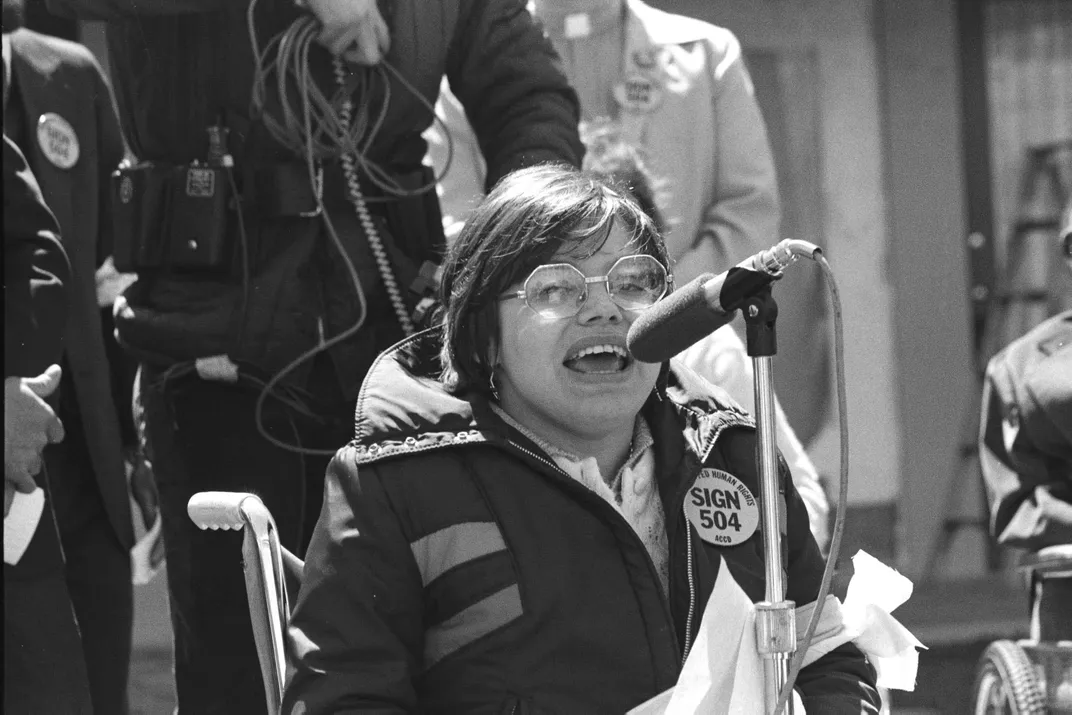
Heumann arrived at the demonstration in her electric wheelchair, wearing a “Sign 504” sticker on her jacket. That was the rally’s objective: pressuring the government to implement Section 504 of the Rehabilitation Act of 1973, America’s first major federal disability rights legislation. Because the provision was only one sentence long, activists had asked officials to issue regulations explaining exactly what it required.
But these regulations remained in limbo four years after the act’s passage. To call attention to the delay, protesters staged demonstrations across the country on April 5, 1977. Heumann helped organize the rally outside the San Francisco Federal Building, which housed the regional offices of the Department of Health, Education and Welfare (HEW).
Several hundred people had gathered by the time she took the microphone. “When I was 5 years old, I was denied the right to school because the school wasn’t accessible,” Heumann told the crowd. “When I was finally allowed to start school in the fourth grade, some of my classmates were 18 years old and still didn’t know how to read.” Under Section 504, these kinds of injustices would become civil rights violations.
At the end of the rally, Heumann asked onlookers to follow her into the building. The throng flooded through the doors and made their way to the fourth floor, where they asked to see Joe Maldonado, HEW’s regional director. A receptionist led a smaller group into his office, with many more crowding the halls outside. When Heumann asked about the status of the regulations, Maldonado seemed confused. “What,” he asked, “is Section 504?” The regional director had never heard of the legislation. Neither had his staff. Heumann was dumbfounded. “We’re not leaving until we get assurances,” she told him.
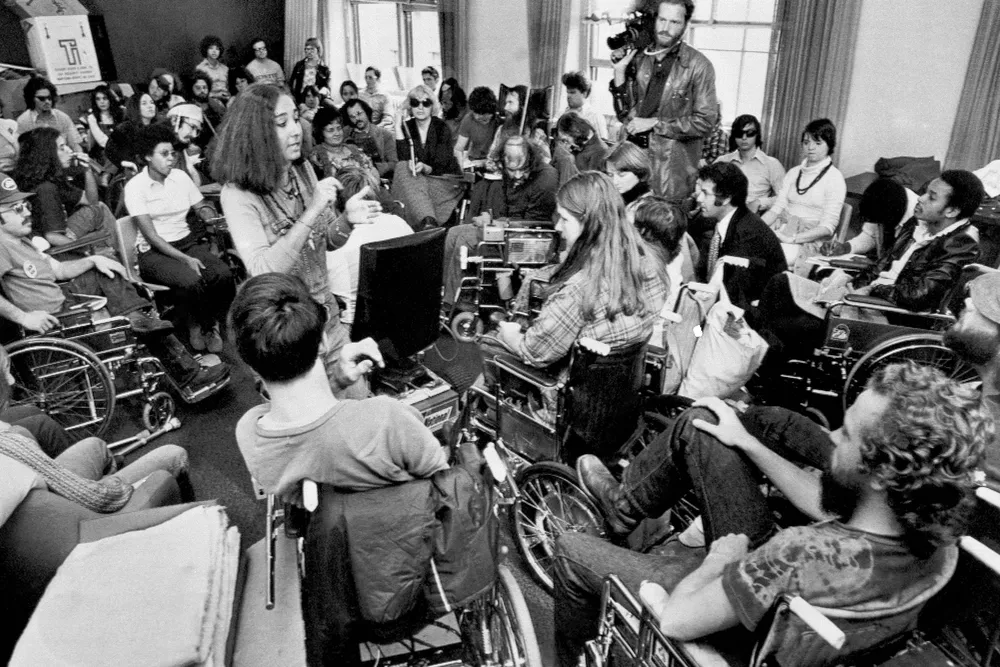
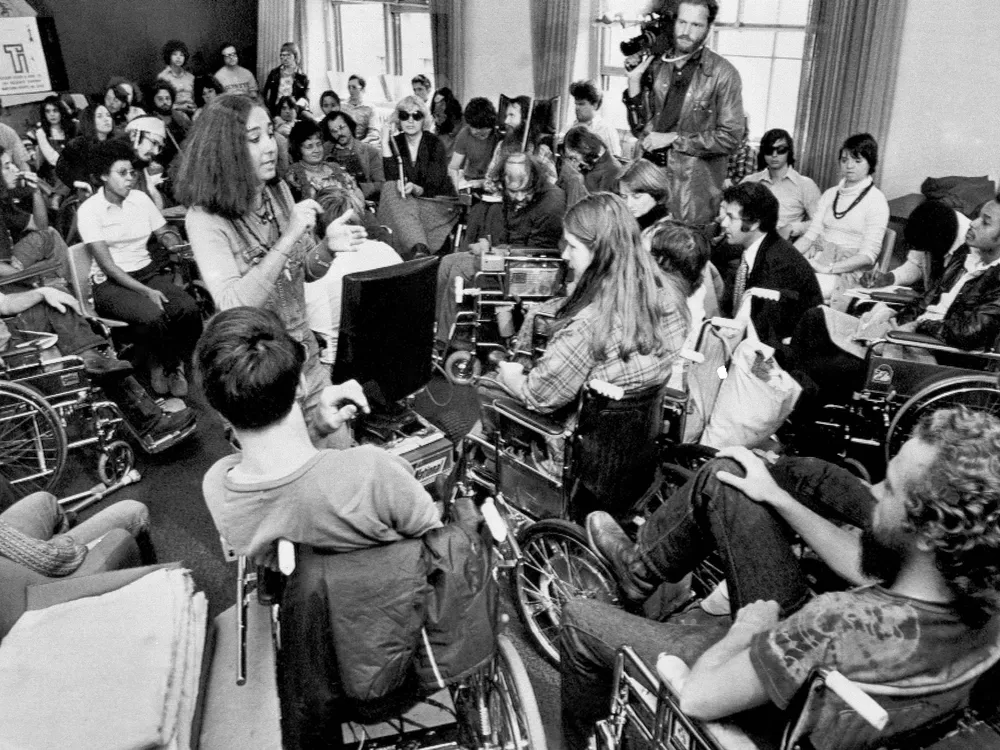
That night, Maldonado and his staff went home, and Heumann asked her fellow protesters to stay the night. Many of them relied on medications, personal aides or specialized equipment. How long could a group with so many medical needs hold out? The answer was 26 days—a record-breaking stretch of time that would make their sit-in the longest peaceful occupation of a federal building in American history.
Nearly half a century later, these activists’ stories form the basis of Being Heumann, a film adapted from Heumann’s memoir of the same name. Arriving in theaters on November 6 and streaming on Apple TV on November 13, the movie dramatizes the standoff between Heumann (played by Ruth Madeley) and then-Secretary of Health, Education and Welfare Joseph A. Califano Jr. (Mark Ruffalo).
Director Siân Heder, the Oscar-winning filmmaker behind 2021’s CODA, decided to focus on the sit-in after reading Heumann’s memoir. “You could have chosen any chapter of her life and made a great movie,” Heder tells Smithsonian magazine. “But when I got to the section of the 504 sit-in, it just felt like this incredibly contained pressure-cooker story.”


The making of Judy Heumann
In 1949, when Heumann was 18 months old, she contracted polio, a virus that left her unable to walk. Her parents were German Jewish immigrants who had lost their own parents in the Holocaust, and they were determined to give their daughter a full life. But when Heumann’s mother tried to enroll her in kindergarten, the principal wouldn’t allow it. He claimed the girl was a “fire hazard.”
Her mother’s efforts ultimately prevailed, but not until Heumann was in fourth grade. She eventually graduated from high school and enrolled at Long Island University, hoping to become a teacher. But she knew that the New York City Board of Education had never previously hired a teacher who used a wheelchair.
After Heumann passed her oral and written exams, only one barrier remained between her and her teaching license: a medical exam. The doctor asked her a series of questions, some of them intimate and humiliating, about her medical history. The board announced its verdict in a letter. “I was officially considered a danger to children because I couldn’t walk,” Heumann wrote in her memoir. “I wasn’t contagious, but somehow I’d been deemed a contaminant.”
Heumann filed a lawsuit against the board. The year was 1970, and the New York Times reported that the 22-year-old hoped to become “the city’s first teacher in a wheelchair.” Officials argued that they needed to protect students’ safety, “such as during fire emergencies,” according to the Times. Heumann retorted that her electric wheelchair allowed her to move faster than colleagues on foot. The board relented.

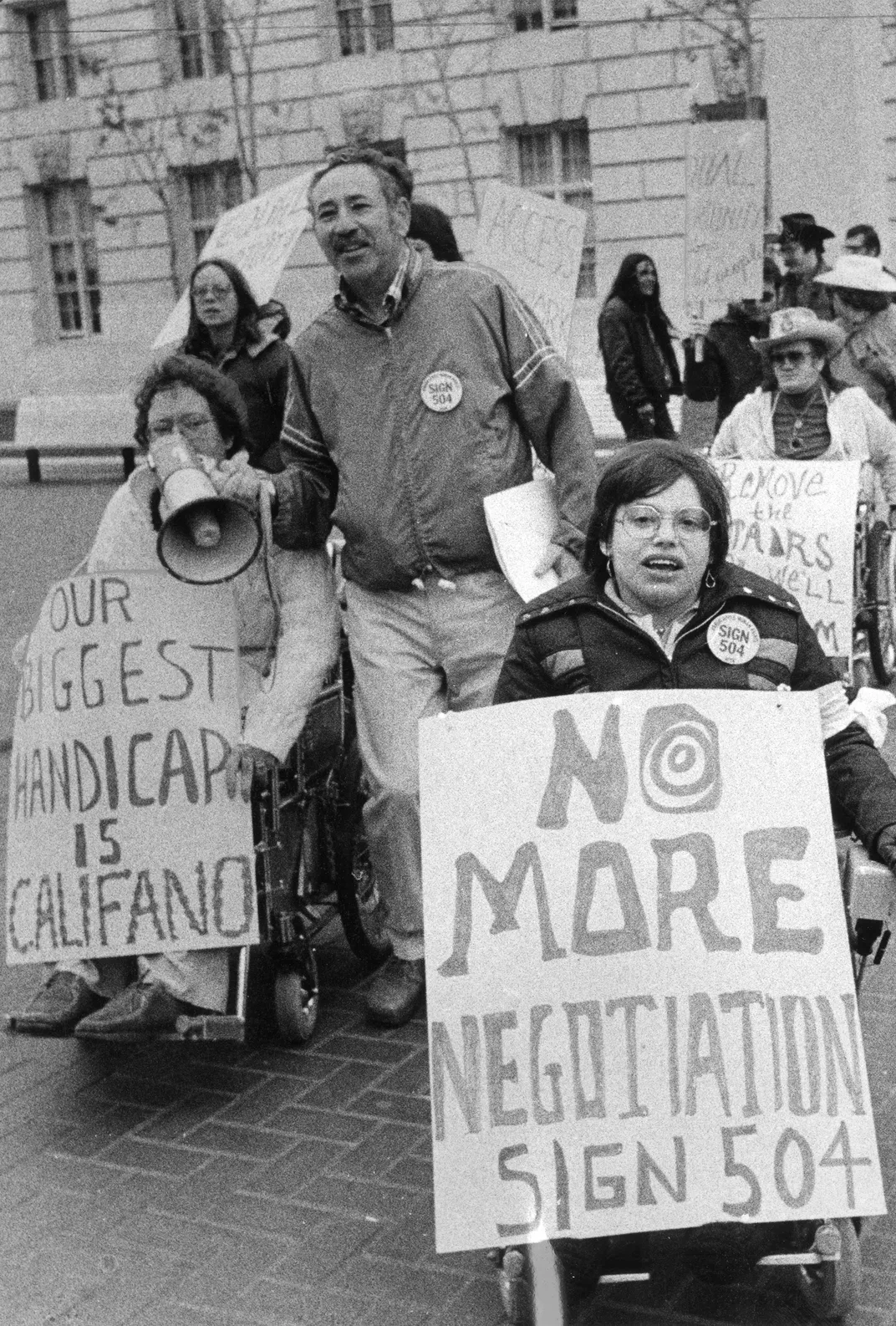
While working as a teacher, Heumann also became involved in disability activism. In 1973, she moved to California to attend graduate school and work with the newly founded Center for Independent Living. Still in her mid-20s, she was already an influential leader. “Judy was different because she was willing to be mouthy,” says Katherine Ott, a curator at the Smithsonian’s National Museum of American History. “She was clever, charming and fierce.” Growing up in a family that knew how to banter, Heumann became a strong speaker who could “think fast in the moment,” Ott tells Smithsonian. “She could think quick and talk back.”
Also in 1973, Congress passed Section 504, which prohibited all recipients of federal funding from discriminating against people with disabilities. Senator Hubert Humphrey had previously tried to attach the language to the Civil Rights Act of 1964, which barred discrimination on the grounds of race, color, religion, sex or national origin. “No longer dare we live with the hypocrisy that the promise of America should have one major exception: millions of children, youth and adults with mental or physical handicaps,” Humphrey had said in a speech on the Senate floor. His proposal failed, but lawmakers included similar language in the Rehabilitation Act:
No otherwise qualified handicapped individual in the United States, as defined in section 7 (6), shall, solely by reason of his handicap, be excluded from the participation in, be denied the benefits of, or be subjected to discrimination under any program or activity receiving federal financial assistance.
Heumann did a double take when she first read Section 504. “This sentence acknowledged that the way we were being treated was actually discrimination,” she wrote in her memoir. “I began to envision what the law could look like. It only covered entities receiving money from the federal government—but that could include so much of what we’d been facing in education, some forms of employment, housing, transportation.”
HEW officials drafted the Section 504 regulations, which included specific requirements and deadlines for schools, universities, hospitals and other federally funded programs, during Gerald Ford’s presidency. But David Mathews, Ford’s HEW secretary, never signed them. When President Jimmy Carter took office in January 1977, Califano, the incoming HEW secretary, wanted to take time to review them before moving forward. “It’s one thing to pass a law,” Ott says. “But if there’s no guidance on how to do it, if there’s no support behind it, if there’s no implementation, then it’s meaningless.”
An occupation army
On the first night of the sit-in, 75 protesters agreed to sleep in the San Francisco Federal Building. “Nothing like that had ever been done before,” Ott says. “Many of them had precarious health conditions, so they had to learn how to take care of each other, to empty leg bags and to give injections.” Some demonstrators needed help transferring in and out of their wheelchairs or turning over in the middle of the night to prevent bedsores. Kitty Cone, one of the event’s organizers, created a medication refrigerator by securing a cardboard box to an air conditioner.
Several demonstrations in other cities also evolved into sit-ins. In Washington, D.C., protesters gathered outside Califano’s office. Climbing onto a coffee table, the secretary explained that he needed time to “study and assess” the regulations, which he promised to sign by early May. “The previous administration took two and a half years to produce a complex regulation that it then refused to sign,” he said. “I believe it is reasonable for me to take two and a half months to examine those regulations.” But the protesters worried that officials would simply use the delay to water down the measures.
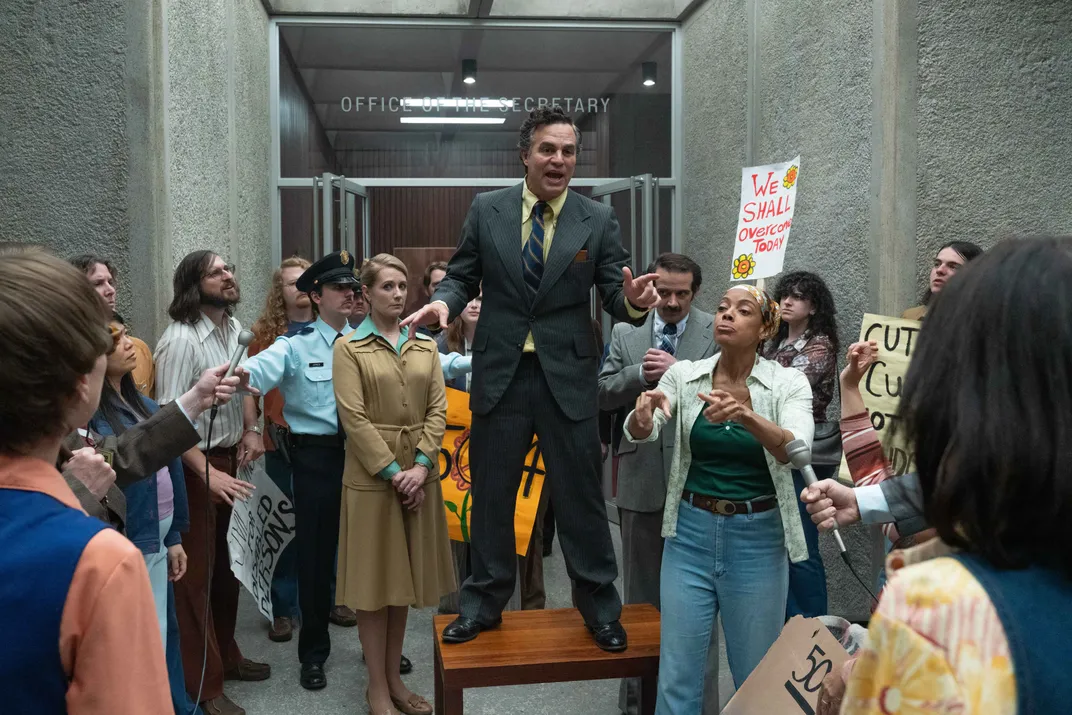
The Washington protesters went home after one night. Security had refused to allow them access to food or medications. Demonstrations in Denver and Los Angeles also quickly disbanded. But in San Francisco, more than 100 protesters agreed to stay on, though nobody was talking about an open-ended occupation. “We couldn’t ask people to stay indefinitely; that would be overwhelming,” Heumann wrote in her memoir. “We could only ask people to commit to one day at a time. ‘Can you stay one more night? Just one night will make a difference.’”
On day three, KGO-TV, a local San Francisco television station, reported that an “occupation army” had taken over the building. “They’re tired. They’re grubby. They’re uncomfortable. But their spirits are soaring,” the outlet added. “The squeeze is on, though. Hot water has been turned off on the fourth floor.” Officials blocked all outgoing calls from the office, limiting the protesters to two payphones in the hallway. “Those in wheelchairs can’t reach the payphone,” KGO-TV explained. “That’s part of what this argument is all about.”
The group devised a new strategy to contact reporters and allies. Deaf protesters stood in the window and signed messages to interpreters outside the building. Other groups, meanwhile, rallied to support the cause, including Glide Memorial Church, the Gay Men’s Butterfly Brigade and the United Farm Workers. Every day, the Black Panthers delivered hot meals to the building.
On day 11, the protesters achieved their first breakthrough: Two California congressmen, Phillip Burton and George Miller, held a congressional hearing on Section 504 inside the building. Eugene Eidenberg, an HEW representative, traveled to San Francisco to answer questions and hear the protesters’ testimony. During one particularly charged exchange, Eidenberg used the phrase “separate but equal” while outlining a hypothetical approach to implementing the regulations in schools.
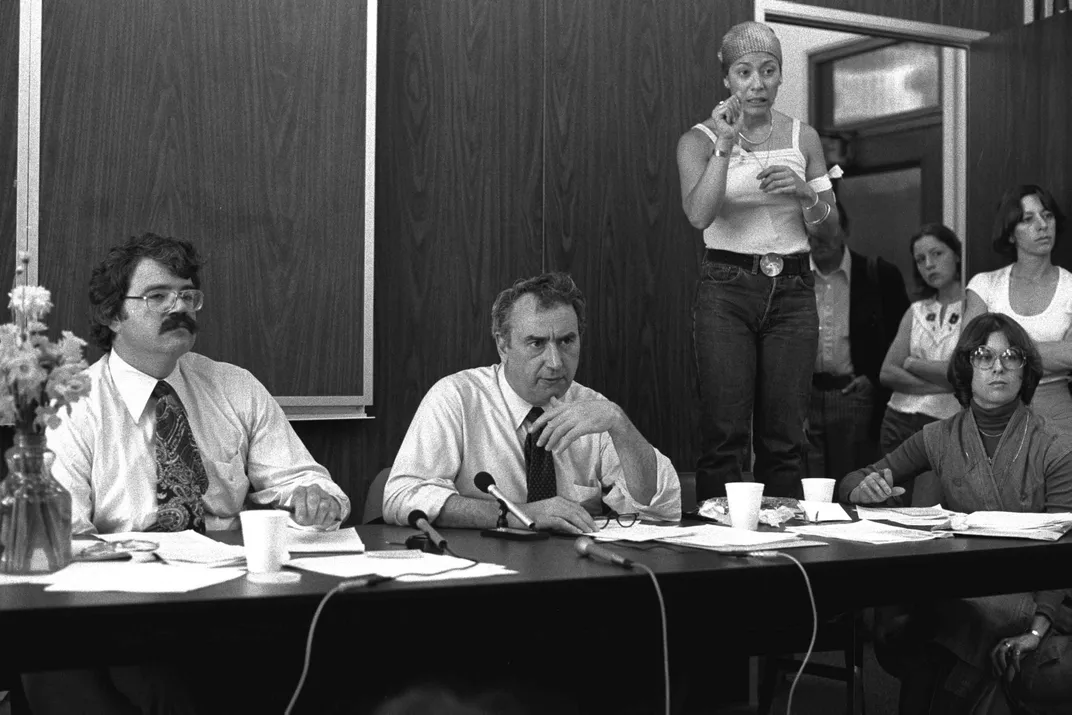
In the days that followed, Eidenberg sought to clarify his remarks, which echoed language that had previously been used to justify racial segregation: “There is no intent, there never was and there won’t be to follow a doctrine of separate but equal,” he told United Press International. “I know how sensitive those words are.” But in the San Francisco Federal Building, the damage was done. To the protesters, the idea that federal officials would speak of options bearing any resemblance to “separate but equal” felt unconscionable.
On day 14, George Moscone, the mayor of San Francisco, brought the demonstrators towels, soap and long hoses that turned the bathroom sinks into makeshift showers. HEW officials wouldn’t allow the showers, saying they weren’t running a hotel. “Why we would make literally a federal case out of something as minimal as this is something that’s just beyond my powers of comprehension,” Moscone said at the time. He threatened to take the matter to Carter and ultimately got the devices through.
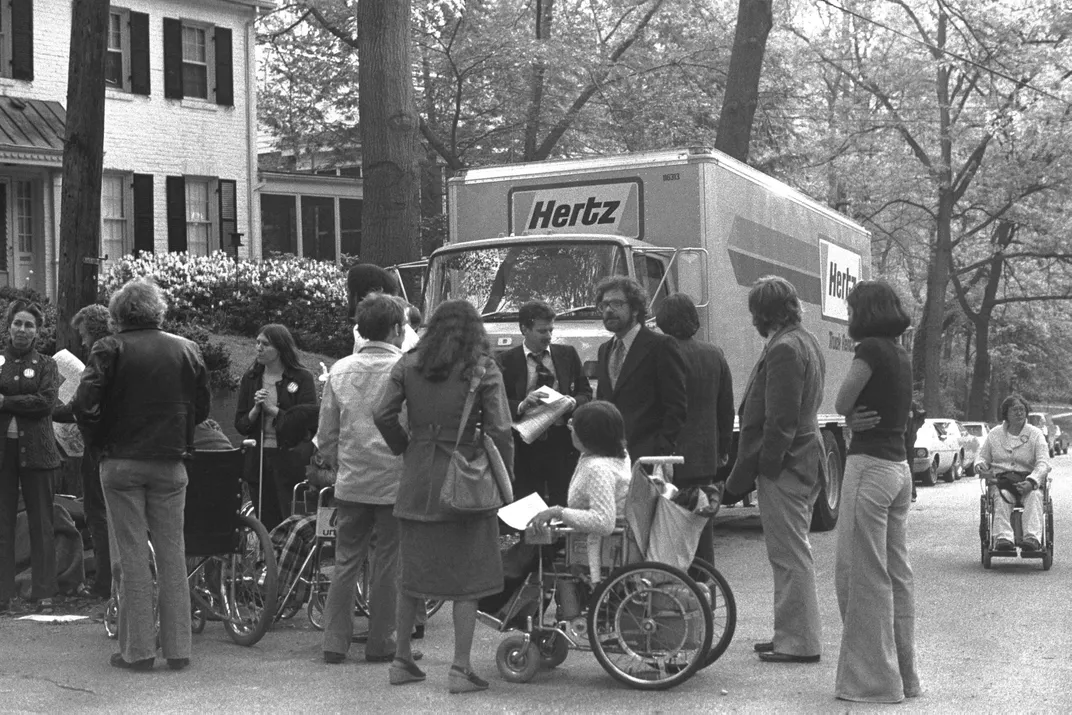
The protesters, meanwhile, decided to send their leaders to Washington while the rest of the group held the building. In her memoir, Heumann described the large moving truck that met them at the airport—the “cheapest and most accessible way” to move so many disabled people around the city. They camped outside of Califano’s house that night, singing freedom songs by candlelight. The secretary snuck out through the back gate in the morning.
The group demonstrated in front of the White House and met with senators. Califano, however, wouldn’t see them. Neither would the president. On April 22, the protesters showed up at the HEW building and tried to request a meeting with the secretary, but security wouldn’t let them inside. Exasperated, Heumann pointed her electric wheelchair at the building. Then she drove straight ahead, slamming into the doors.
The birth of a movement
In his 2004 memoir, Califano wrote that he had “welcomed” the Section 504 demonstrations. “To my surprise, I found myself touched by their sincerity,” he added. He thought about what he’d learned at his Catholic elementary school, that all humans are created in God’s image. “It was the first time I’d been called upon to live that lesson,” he wrote, “and under these circumstances, it wasn’t easy.”
As the early May deadline approached, the protesters became increasingly confident that Califano would act. Many of the leaders who had traveled to Washington returned to the West Coast. “We expect the signing of 504 … within the week,” Cone told the San Francisco Chronicle on April 27. The next day, Heumann, who had stayed behind in the nation’s capital, was at a bar in Capitol Hill when she saw the news on TV: Califano had signed the regulations with only minimal changes.
Thousands of organizations receiving federal funds would now need to spend billions of dollars to make their services accessible. More disabled children would be able to attend the same schools as their siblings; disabled undergraduates could enroll in college courses alongside their peers. Hospitals would be required to communicate effectively with deaf patients, and employers would need to provide reasonable accommodations to qualified employees.
Speaking to the press, the secretary seemed enthusiastic. “It’s the law of the land,” he told the Associated Press. “Let’s do it.” The AP noted that millions of disabled children were “segregated into separate classrooms or institutions,” and roughly one million were “not receiving any education.” Califano would later reflect that his “sense of civil rights” had “focused on race” before Section 504. He quickly realized that the “sweeping language was tantamount to another major civil rights law, and it covered about 35 million Americans, almost one-sixth of the population.”

Like Califano, most Americans had never considered disability a civil rights issue. “People weren’t used to thinking of us as fighters—when they thought about us at all,” Heumann wrote in her memoir. “We were seen as helpless and childlike, as the kind of people for whom you felt pity and raised money.” Disability was often associated with telethons, which tugged on viewers’ heartstrings by showing images of sick children. For decades, Americans had understood disability through “the medical model of rehabilitation, charity and paternalism,” Cone wrote in 2013. Section 504 challenged that perspective, reframing access as a social responsibility.
At the San Francisco Federal Building, many of the protesters were learning about this new framework for the first time themselves. “We were very conscious that history was being made,” activist Ken Stein said in a 1997 audio documentary. “If there was a Stonewall of the disability rights movement, if there was a Birmingham bus boycott of the disability rights movement, this was it.”
When Califano signed the regulations, the protesters celebrated with “victorious shouting, hugging, laughter and, ultimately, crying. Because, as it turned out, people didn’t want to leave the building,” Heumann wrote in her memoir. “Nobody expected to feel as heartbroken as they did that the sit-in was ending.” The group spent one final night in the building before returning to a world that was finally becoming easier to navigate.
The legacy of Section 504
Thirteen years later, in 1990, the Americans With Disabilities Act passed with bipartisan support. The landmark legislation barred discrimination against disabled Americans in all areas of public life. “With Section 504, we were able to show America that our society could become accessible,” Heumann later reflected. “Through outlawing discrimination against disabled people in all institutions receiving federal funds, we set the stage for building inclusive institutions everywhere.”
Many American students study the civil rights movement in school, but few learn about legislation like Section 504. Heder discovered Heumann’s story because her friend was working as an accessibility consultant on Crip Camp, a 2020 documentary featuring the activist as a central character. “After I read her book, I reached out to Judy. I sent her a cold email and said, ‘I would love to make a movie about you,’” Heder recalls. “She wrote me back 20 minutes later and said, ‘I’m making a movie about my life and I’m in the last 24 hours of deciding on a filmmaker—and if you can meet with me at 5 o’clock today, I’ll consider you.’” Heder got the gig.
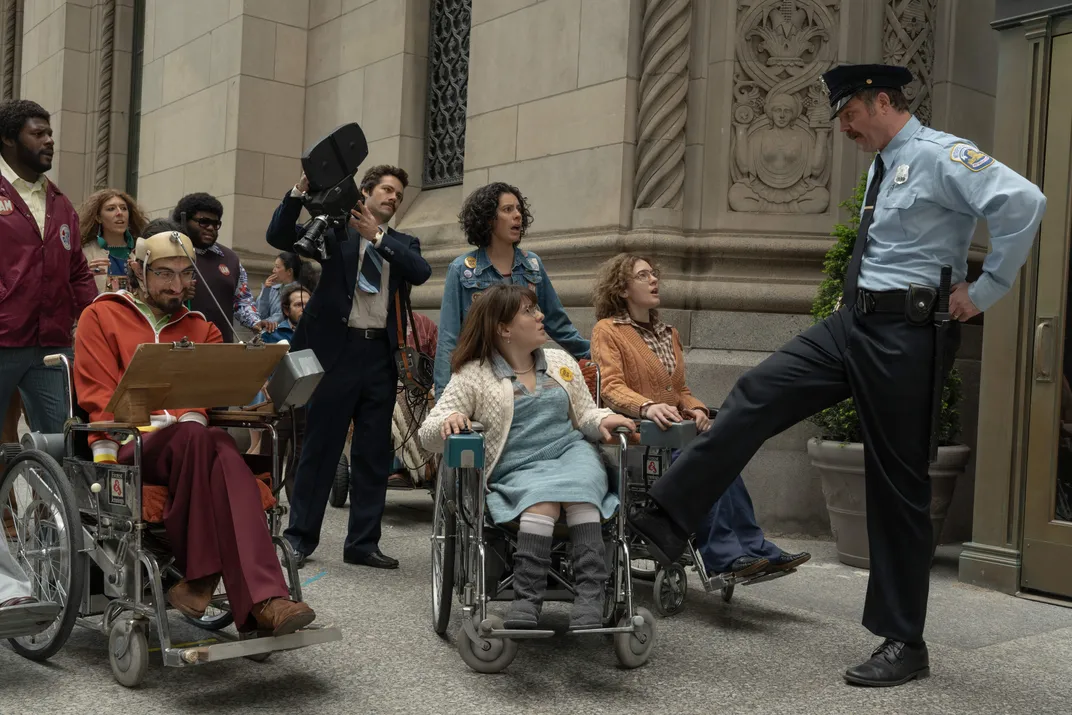
The director hopes the film will help viewers understand the social model of disability that Heumann advocated for. As the activist wrote in her memoir, “From our perspective, disability was something that could happen to anyone at any time and frequently did, so it was right for society to design its infrastructure and systems around this fact of life.” Americans without disabilities can also benefit from accessibility. For example, Heder was grateful for curb cuts and elevators when she was a new mom pushing a stroller.
To prepare for the film, Heder conducted extensive interviews with protesters who were still alive, piecing together additional details from oral histories and old newspapers. “A lot of people were passing away as I was reaching out to them,” she says. “Hale Zukas died, and Ron Washington died, and I felt like we were losing people—and we were losing this history along with the people.” After working with Heder for two years, Heumann died in 2023 at age 75.
Quick facts: Smithsonian objects in Being Heumann
- While working on the film, Heder’s team replicated original T-shirts and buttons from the collections of the Smithsonian’s National Museum of American History.
- “As we lose the people, it’s the artifacts that tell the story,” Heder says. “The institutions that archived pieces of this protest were so key to building the movie.”
Because the 504 sit-in remains so little known, Heder wanted to avoid heavily fictionalizing the history. She had always imagined Heumann rolling out of the building with the group at the end of the protest, but the activist pointed out that she’d actually been in Washington at the time. “It was a challenge as a writer,” Heder says. “I thought, ‘How do I make that work?’ And yet it was so in character for Judy. She didn’t have time to celebrate. She was hyper-focused on the next fight.”

Heumann fought for disability rights for the rest of her life. Working with a cast of disabled actors on Being Heumann, Heder saw up close how many barriers remain. At the Los Angeles premiere, for example, the cast couldn’t hold a Q&A from the front of the stage because the space wasn’t accessible. “It’s an old theater, and I don’t think they have thought that they needed to include disabled people as talent who might ever need to appear onstage,” the director says. “The act of making this movie, the act of putting disabled actors on screen, feels like it’s pushing forward the work that Judy was doing.”
Heder co-wrote the screenplay with Rebekah Taussig, a writer who has used a wheelchair since childhood. When Taussig flew home from a table read in Los Angeles, the airline lost her wheelchair; the frame later turned up on her doorstep. “They never found the wheels,” she writes in Time. “A replacement pair arrived three weeks later.”
Taussig had never learned about Section 504 in school. But when she told Heumann about her life, she “saw more clearly than ever before how she and other activists had shaped it.” Growing up, she had attended school down the street from her home. She then spent several years teaching. In job interviews, her wheelchair never came up once.
