
Scientists Found This Mysterious Golden Orb on the Seafloor Nearly Three Years Ago. Now, They Finally Know What It Is
After a long, winding road of tests, researchers at the Smithsonian’s National Museum of Natural History and other institutions determined that the strange blob once attached a large sea anemone to a rock
/https://tf-cmsv2-smithsonianmag-media.s3.amazonaws.com/accounts/headshot/SarahKuta.png)
:focal(2736x1824:2737x1825)/https://tf-cmsv2-smithsonianmag-media.s3.amazonaws.com/filer_public/e0/e7/e0e7259c-b3c6-4123-8482-7d8cb289af4c/golden-orb.jpg)
In August 2023, scientists found a mysterious object stuck to a rock on the ocean floor off the coast of Alaska. They carefully extracted the four-inch-wide, tannish-gold orb and brought it to the surface—but, even then, they still couldn’t identify the unusual-looking specimen, beyond that it was “biological in origin.”
“Everyone was like, ‘What the heck? What is that?’” Allen Collins, a zoologist at the Smithsonian’s National Museum of Natural History (NMNH), tells Live Science’s Chris Simms.
Now, nearly three years later, Collins and his colleagues say they finally know what it was. The enigmatic blob was the remnants of a durable outer layer, or cuticle, and tissue that once attached a large sea anemone to the rock, the researchers report in a paper posted April 21 on the preprint server bioRxiv.

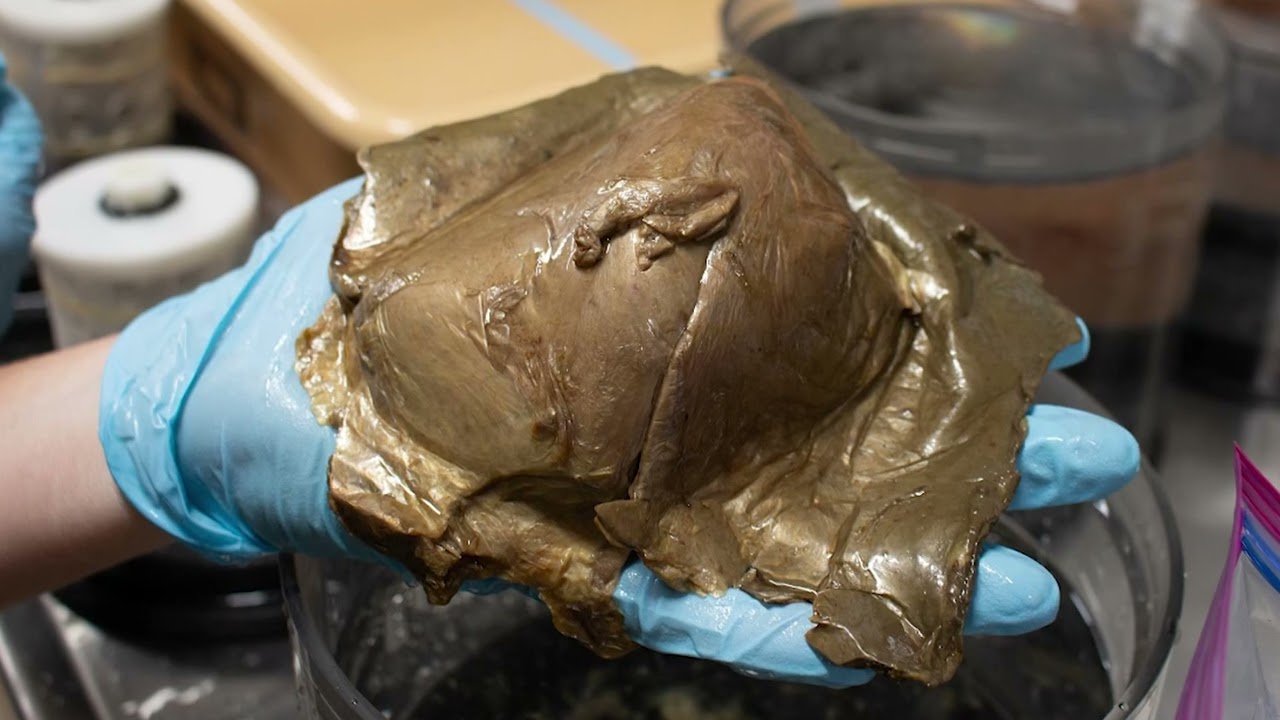
The results, which have not been peer-reviewed, “provide closure to the case of the golden orb,” the study authors write. “The curiosity of the specimen, and speculation surrounding its discovery, underscores the importance of exploration and scientific collections.”
Researchers stumbled upon the blob while using a remotely operated vehicle (ROV) to explore the seafloor west of Prince of Wales Island as part of a regional mapping project called Seascape Alaska. The strange specimen was more than two miles beneath the water’s surface, and scientists initially wondered whether it might be an egg casing or some sort of sponge.
Intrigued, they used the ROV’s suction tube to carefully collect the material and bring it back to their ship, the National Oceanic and Atmospheric Administration’s (NOAA) Okeanos Explorer. But when they investigated the orb in the vessel’s wet lab, they still couldn’t identify what it was.
Did you know? You can explore the seafloor with the ROV
In 2023, viewers watched and listened as scientists puzzled over the mysterious golden orb and eventually vacuumed it up. When the Okeanos Explorer is out investigating the ocean, you can follow along via a livestream.
So, they sent it to NMNH, where researchers first gave the specimen a thorough once-over for any obvious anatomical clues about its identity—like muscles or a mouth. That wasn’t fruitful, so they looked at the orb under a microscope. The approach revealed special stinging cells found in creatures like jellyfish, sea anemones and corals. Specifically, the cell type belonged to the Hexacorallia class, narrowing the search to around 4,000 species.
Next up was genetic testing, although initial results came back inconclusive, probably because the samples were contaminated by other microscopic life forms. However, when the researchers analyzed the complete set of DNA, or genome, from the object, they found “a large amount of genetic material” from the anemone Relicanthus daphneae, which an additional analysis confirmed, according to a statement.
/https://tf-cmsv2-smithsonianmag-media.s3.amazonaws.com/filer_public/5b/f0/5bf0141d-49b7-45d9-8814-56fafd757043/ex1605l1_img_20160421t001035z_rovhd_acn.jpg)
“It’s great to have an answer to what the golden orb is, and as is often the case in the deep sea, it’s a surprise,” says Jon Copley, a marine ecologist with the University of Southampton in England, who was not involved with the research, to Live Science. “From its looks alone, we didn’t guess it would be the remnants of an anemone-like animal.”
R. daphneae has been perplexing scientists for decades, so the golden orb puzzle only adds to its mystique. First discovered in the 1970s, the creatures are massive, with tentacles that can grow nearly seven feet long. Based on its anatomy, scientists initially thought R. daphneae was a sea anemone. However, when they investigated a handful of the species’ genes, they determined it was not an anemone after all, suggesting it might belong to a new order of animals instead. But in 2019, they reversed course and once again said it was an anemone, though one that likely belongs to its own suborder.
The debate over R. daphneae continues today, with some scientists arguing it should be referred to as “anemone-like.” Others suspect it stems from an ancient anemone lineage, which is why it has been so difficult to categorize.
/https://tf-cmsv2-smithsonianmag-media.s3.amazonaws.com/filer_public/e4/f1/e4f17d16-3bfc-4e26-a85b-44b1068ef62a/orb-hires.webp)
These large creatures are often found near deep-sea hydrothermal vents, where scientists think they perch on the current-exposed sides of boulders and use their long tentacles to snag prey like vent shrimp. It appears the animals secrete layers of cuticle from their broad bases to help attach themselves to rocks.
When the study authors revisited photos and videos of R. daphneae in its natural habitat, they realized the cuticle is often visible beneath the rest of the animal’s body. Additionally, the scientists found one image that appears to show “a trail of golden material,” as if an individual had moved sideways across a rocky surface, they write in the paper.
It’s not clear what happened to the individual that left the golden orb behind, says Emily Crum, a spokesperson for NOAA Ocean Exploration, to the Alaska Beacon’s Yereth Rosen. However, past observations suggest that R. daphneae can detach their bodies and leave their cuticles behind when they move, per Live Science. The ability might also explain why most R. daphneae specimens that have been collected over the years do not have cuticles.
“So often in deep ocean exploration, we find these captivating mysteries, like the golden orb,” says William Mowitt, acting director of NOAA Ocean Exploration, in the statement. “This is why we keep exploring—to unlock the secrets of the deep and better understand how the ocean and its resources can drive economic growth, strengthen our national security and sustain our planet.”
/https://tf-cmsv2-smithsonianmag-media.s3.amazonaws.com/accounts/headshot/SarahKuta.png)