
Scientists Say They’ve Found Preserved Dinosaur Blood in a 115-Million-Year-Old Fossil, but Not Everyone Is Convinced
Soft tissues like blood generally break down relatively quickly after death. Environmental factors can also produce red blood cell look-alikes, so many outside researchers are cautious about the new study’s claims

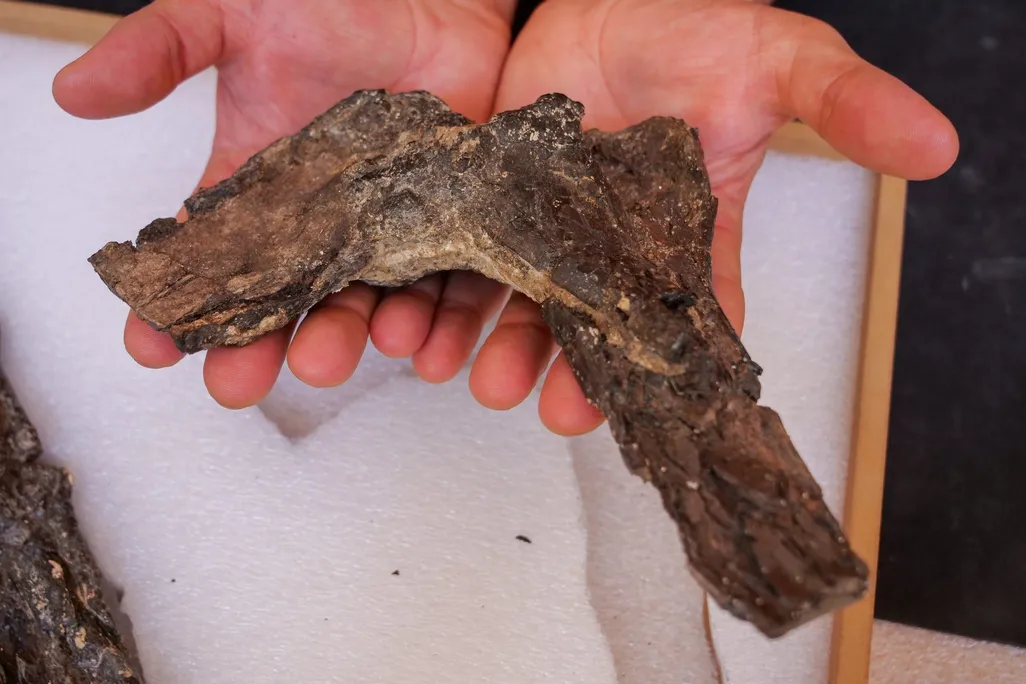
Scientists say they’ve discovered blood inside a 115-million-year-old dinosaur bone. That’s backed by their detection of heme, an iron-rich molecule in hemoglobin, the protein in red blood cells that carries oxygen and gives blood its red color. The findings, described November 2 in the Proceedings of the National Academy of Sciences, potentially represent the oldest red blood cells ever found in a dinosaur fossil.
“Evidence from microscopy, mineralogy, spectroscopy and molecular geochemistry all point toward the same conclusion,” lead author Kliti Grice, a geochemist at Curtin University in Australia, writes for the Conversation. “We are convinced these are fossilized red blood cell structures containing traces of heme molecules.”
However, some outside experts remain unconvinced.
Grice and colleagues made their discoveries while analyzing a hind leg bone of an Aratasaurus museunacionali, a small, bipedal, meat-eating dinosaur that lived during the Cretaceous period. This individual is believed to have been about 4 years old when it died; it wasn’t yet fully grown, weighing an estimated 75 pounds and measuring about 10 feet long.
Discovered in a mine in northeastern Brazil in 2008, the fossil eventually went to the country’s National Museum in Rio de Janeiro. In 2024, experts sent it to Grice and colleagues, who had agreed to investigate the specimen. The scientists did that by first slicing off thin sections, then using hydrochloric acid to remove the surrounding rock.
Did you know? Survivor of fire
In 2018, a fire destroyed millions of objects in Brazil’s National Museum—the oldest national history museum in the Americas. A. museunacionali’s name is a combination of Greek and the Indigenous Brazilian language Tupi that translates to “the dinosaur born from the National Museum fire.”
When they looked at the fossil slices under a high-resolution microscope, they spotted numerous structures that resembled red blood cells. The blobs were round with sunken centers, each measuring about 23 micrometers long by 20 micrometers wide. Additionally, they were located inside vascular canals—the channels that carried blood vessels through the bone while the animal was alive.
“I was jumping up and down,” Grice tells New Scientist’s James Woodford. “I ran up to my head of school’s office and was so excited that he gave me a whisky to calm me down.”
To confirm their hunch, the team performed several types of analyses on the samples. These tests revealed two chemical fingerprints of heme, including a degraded form of the molecule that hints at its ancient origins.
When they performed similar analyses on the sediment surrounding the fossil, they got very different results. They mostly found evidence of plants and bacteria, with only small traces of heme. This, the researchers say, suggests the fossilized bone samples were not contaminated.
Additionally, the scientists compared the structures to the blood cells of birds and crocodiles, the closest living relatives of dinosaurs. The A. museunacionali cells were longer and wider than the bird and crocodile blood cells. However, the researchers suspect the A. museunacionali cells might have gotten deformed as the bone turned to fossil; another possible explanation is that dinosaurs’ red blood cells were simply shaped differently.
The scientists also found evidence of an amino acid found in collagen, a structural protein that provides strength, support and elasticity to the body’s tissues.
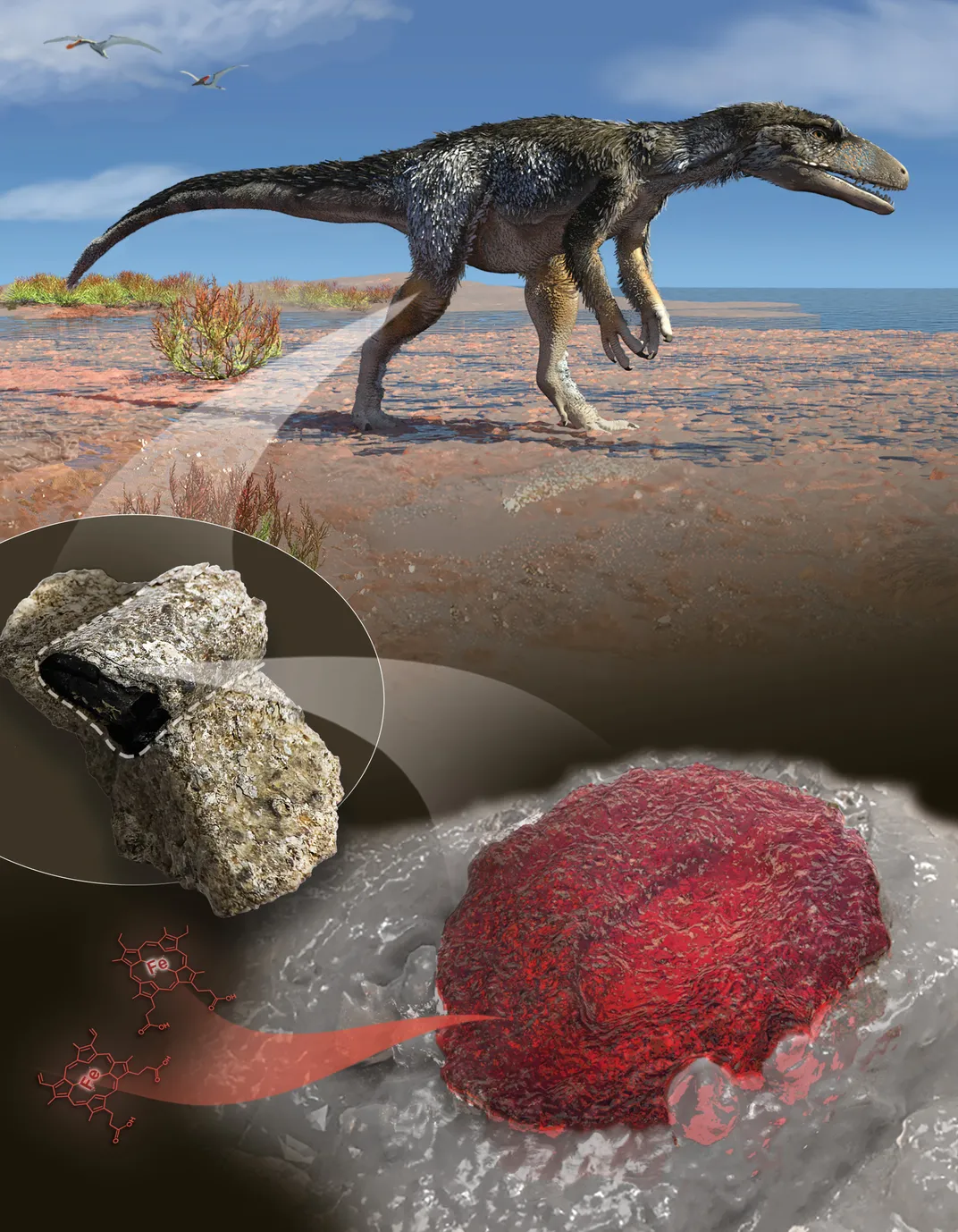
Taken together, the findings point to the discovery of red blood cells, the researchers argue. If confirmed, this would mark the first time red blood cells with the chemical signature of heme have ever been found inside a dinosaur fossil.
“What we believe is distinctive about the present study is the strength of the combined evidence: numerous red-blood-cell-like structures in situ within the dinosaur bone, their mineralization, their location in the vascular system and associated in situ chemical evidence related to heme,” Grice tells Reuters’ Will Dunham. “To the best of our knowledge, that combination has not previously been demonstrated in a dinosaur fossil in this way.”


Still, scientists have made similar claims before. According to Science’s Rodrigo Pérez Ortega, at least 14 studies have tried to describe red blood cells in ancient fossils. However, these findings remain controversial because soft tissues, including blood, break down relatively quickly after an animal dies and are rarely preserved. Additionally, certain minerals look very similar to red blood cells under a microscope, meaning what appears to be evidence of ancient blood may actually be a geologic look-alike. Contamination—from both ancient and modern sources—can also be an issue.
Researchers were skeptical of the new study for the same reasons. Maria McNamara, a paleobiologist at University College Cork in Ireland who was not involved with the new study, tells Science that the paper is “probably the most comprehensive effort that’s been done so far.” However, she would still be “very cautious about interpreting those necessarily as red blood cells.”
Nevertheless, Grice and her colleagues stand by their conclusions, arguing their work demonstrates that fossilized soft tissues can and do survive for millions of years under certain conditions. They suspect this creature’s vascular structures were preserved because of what happened after it died: It was quickly buried by water and sediments full of microorganisms, creating conditions that slowed decay. Hausmannite, a manganese oxide mineral, may have helped preserve the red blood cells specifically, reports Live Science’s Kenna Hughes-Castleberry.
The scientists say the techniques they used could help researchers uncover previously overlooked biological material in other fossils, which could “potentially help us ask much more sophisticated questions about the physiology of extinct animals,” Grice tells CNN’s Taylor Nicioli.
“Bones provide extraordinary information about anatomy, growth, locomotion and evolution,” she adds. “But cellular and molecular preservation potentially gives us access to a different layer of biological information: the chemistry of the living animal and its tissues.”
